How a Spiral Duct Machine Works: Step-By-Step Pipe Production Explained
Jump to section
A spiral duct machine turns a flat metal coil into round pipe in one continuous run. The strip feeds through rollers. The rollers wind it into a helix and fold the edges into a seam. A cutter then trims the pipe to length. No welding is needed, and no hand fabrication either. This guide follows the process from coil to finished pipe. It also compares lock-seam forming with welded forming, and shows how duct ends and fittings are finished afterwards.
A spiral duct machine is a roll-forming line that converts flat metal coil into round, spiral-seamed duct. A production model forms diameters from 80 mm to 1600 mm. That range covers small branch runs in homes and large mains in factories. The sections below cover the materials it accepts and the parts that do the work.
Spiral duct machines run three metals: galvanized steel, stainless steel, and aluminium. Thickness limits differ by metal. Galvanized steel and aluminium run from 0.4 to 1.3 mm. Stainless steel runs from 0.4 to 0.8 mm, because it work-hardens faster under the rollers.
Strip width is tied to thickness. Material from 0.4 to 1.0 mm uses a 137 mm strip. Material from 1.1 to 1.3 mm uses a 140 mm strip. The wider strip gives the seam rollers more metal to fold at the heavier gauges.
Coil size drives handling, not forming. Heavier coils need a powered decoiler and lifting gear. The strip then feeds without pause until the coil runs out, so pipe length is limited by floor space rather than by the machine.
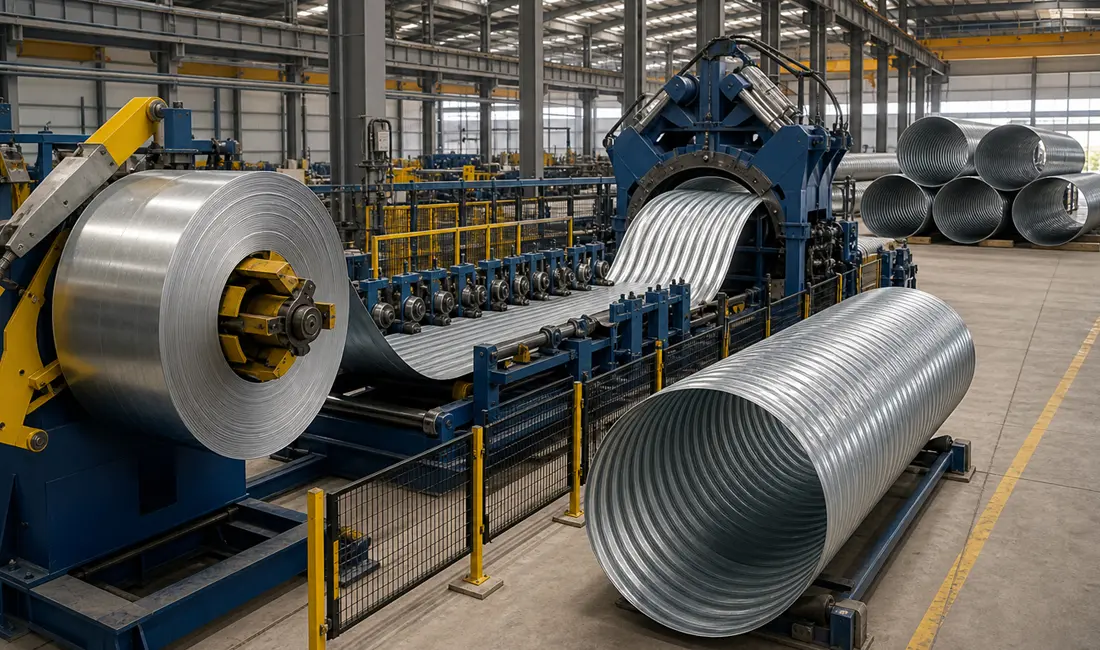
Four parts do the real work. The decoiler holds the coil and pays out the strip at a steady tension. Straightening rollers take the curl out of the metal. The forming head winds the flat strip into a helix at the set diameter. The seam rollers then fold and press the edges shut.
Forming moulds set the diameter. Cast aluminium moulds weigh far less than steel ones, so operators can change diameters faster and without lifting gear. Industrial spiral duct machines come with a large mould library that covers standard and custom sizes.
A programmable logic controller, or PLC, ties the line together. It sets feed speed, tracks pipe length, and fires the cutter at the target length. A complete line ships as three units: main machine, decoiler, and run-out table.
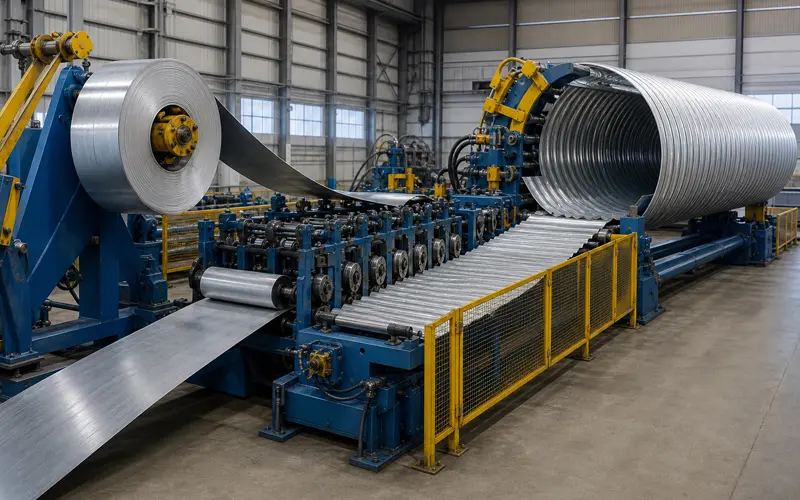
The line works in three stages. It uncoils and flattens the strip. It forms and locks the spiral seam. It then cuts the pipe to length. Each stage below feeds the next, so a fault early in the line always shows up later in the pipe.
The decoiler grips the coil and feeds the strip at steady tension. Loose tension lets the strip wander. Tight tension stretches it. Either fault shows up as an uneven seam further down the line.
Straightening rollers then remove the curl left by winding. Operators set the roller gap to match the metal thickness. Edge guides centre the strip so it enters the forming head square.
A quick check before loading saves downtime later. Rust, dents, and burrs on the strip edge all cause seam faults or jams. Clean strip feeds cleanly at speeds up to 60 m/min.
The forming head bends the flat strip into a helix. Each wrap meets the edge of the wrap before it. The tube supports itself as it grows, so the process never stops.
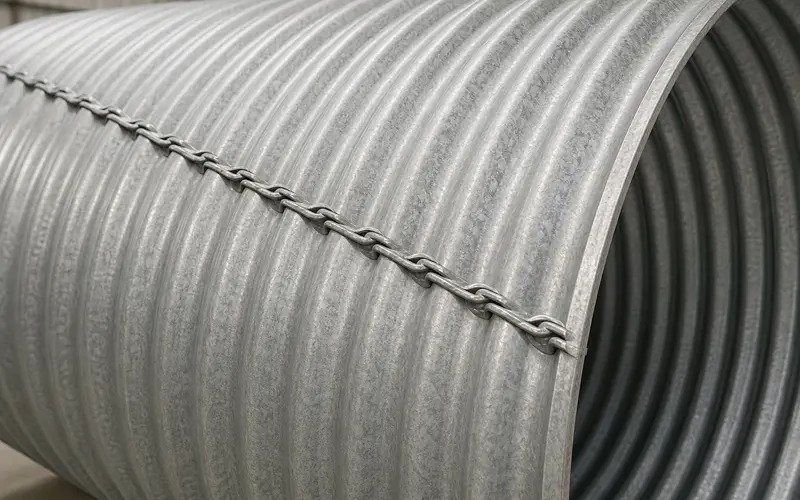
A lock seam is a folded joint that hooks the two strip edges together without heat. Seaming rollers fold the overlap, then press it flat in stages. Most ducts use an outside lock seam, which sits proud of the outer wall. A spiral lock-seam forming machine can also run an inside seam where a smoother outside face matters.
Cold folding protects the metal. There is no heat, so the galvanised coating stays intact and the pipe wall does not distort. A well-formed seam holds standard HVAC pressures, which for spiral duct means ratings up to about 2,500 Pa, or 10 inches water gauge.
The PLC tracks pipe length as the tube leaves the forming head. It fires the cutter at the set length, so no one has to measure by hand.
A slitting cutter separates the pipe while the line keeps running. It cuts without sparks and without burrs, so cut ends need no grinding before the next step. That matters in shops where open sparks are restricted.
Cut pipes drop onto a run-out table. Automatic turning after the cut reduces manual handling and keeps the line moving.
Lock-seam forming folds the strip edges together cold. Welded forming fuses them with heat. Both produce round spiral duct, but they differ in seam shape, equipment, and best use. The comparison below covers those differences and then sets out which method suits which job.
Lock-seam machines fold and press. They need no welder, no shielding gas, and no welding skill on the shop floor. The finished seam leaves a small raised ridge inside the pipe.
Welded machines fuse. A welded spiral forming unit runs a continuous seam along the spiral joint as the tube forms. The seam sits flush with the wall, so the bore stays smooth from end to end. Welded lines also carry more equipment. A typical cell includes an uncoiler, forming machine, welding unit, cut-off system, support frames, and a loading frame.
Lock-seam and welded forming trade speed against surface quality.
| Attribute | Lock-seam forming | Welded forming |
| Joining method | Cold folded seam | Continuous arc weld |
| Interior surface | Small raised ridge | Flush and smooth |
| Coating | Galvanised layer stays intact | Heat affects the coating |
| Equipment on the line | Forming and seaming only | Adds welding unit and supply |
| Operator skill | No welding skill needed | Welding skill required |
| Best fit | Standard air movement | Material-carrying duct |
Lock-seam forming wins on simplicity and output. Welded forming wins on bore quality and joint strength. Neither is better in general terms. The application decides.
Choose lock-seam forming for standard air movement. Commercial HVAC, office ventilation, and building services all suit it. The method also keeps the galvanised coating intact, which matters for corrosion life in normal indoor duct.
Choose welded forming when material moves through the pipe. Dust extraction, fume collection, and pneumatic conveying all need a smooth bore, because an internal ridge collects dust and starts blockages. Welded seams also suit stainless duct in food plants and clean rooms, where the pipe gets washed down.
Output and product mix settle the rest. A shop running high volumes of standard round duct gets more from a lock-seam line. A fabricator serving industrial clients, or one making short pipe sections and couplings, gets more from a welded line.
Straight pipe is only half the job. Duct ends need shaping so sections join tightly, and elbows, reducers, and branches are made on separate machines. The two sections below cover end forming first, then fittings.
End forming decides how well two sections join. Three operations cover most jobs, and each does a different thing.
Swaging is an end-forming step that shrinks one pipe end slightly. The smaller end then slips inside the next section for a quick field joint. Only the end is reduced, over a short length, so the rest of the pipe keeps its diameter.
Beading is a rolling step that presses a raised rib around the pipe. The rib stiffens the end and gives sealant and clamps something to grip.
Flanging bends the pipe edge outward to take a bolted flange. Flanged joints suit higher pressures and large diameters, where slip joints alone are not enough.
Elbows are built from segments called gores. A gore is an angled slice of pipe, and several gores joined together form a smooth curve. Fabricators cut the segments, then join them by spot welding or seam welding.
Reducers step one diameter down to another. A cone is rolled from flat sheet, then closed along its length and joined to the pipe ends.
Branch fittings connect smaller runs to a main. Workers cut an opening in the main, fit a collar or a saddle tap, and seal the joint. Larger shops cut these openings on a plasma cutter, which handles stainless steel cleanly.
Three faults cause most open seams. Seam roller pressure is too low for the gauge. Strip tension drifts, so the overlap wanders. Or the strip edge is damaged before it reaches the head. Check roller pressure first, since it is the fastest to correct.
Changeover time depends mostly on mould weight. Cast aluminium moulds are light enough to swap by hand, which avoids waiting for lifting gear. Shops that group orders by diameter cut the number of changeovers per shift, which usually saves more time than speeding up each one.
No. A spiral line makes straight pipe. Elbows, reducers, and branches need separate elbow forming, welding, and cutting equipment. Most fabricators size the spiral line first, then add fitting machines to match the pipe mix they sell.
The process comes down to a few points. Feed clean strip at steady tension. Match strip width to metal thickness. Fold the seam cold to protect the coating. Cut with a system that leaves no burr. Then finish the ends to suit the joint the site will use.
Equipment choice follows the product, not the other way round. Diameter range, sheet thickness, seam type, and fitting mix decide the line. BOBO Machine builds spiral duct lines and fitting equipment for this work. Share duct diameters, sheet thickness, fitting types, and target output through the contact page, and the engineering team can confirm a suitable machine and line layout.