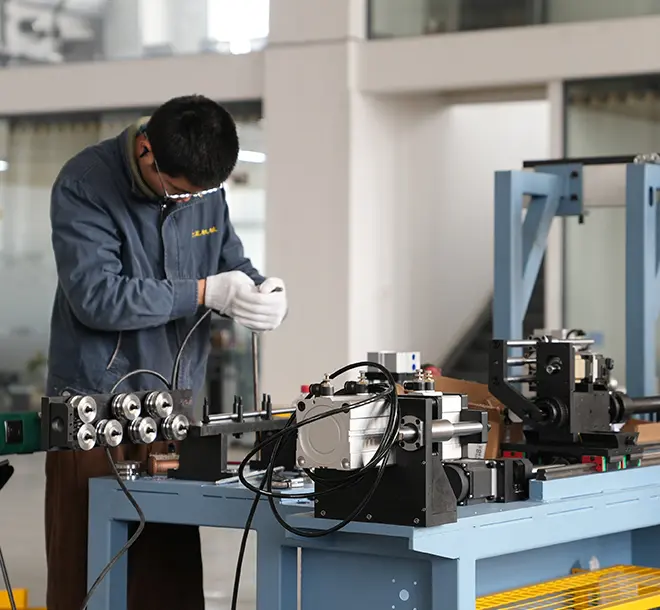
Spiral Corrugated Culvert Pipe: Production Process from Coil to Finished Pipe
Jump to section
A culvert pipe with shallow corrugations or a loose spiral seam can fail once it goes into the ground. Soil pushes on a buried pipe from every side. A weak wave profile or seam can let the pipe flex out of round or collapse. A single coil of galvanized steel becomes a pipe that must resist this pressure for decades. Every step between the coil and the finished pipe shapes whether it succeeds. This guide walks through that process in order. It covers the quality checks and equipment that keep the result consistent.
Spiral corrugated culvert pipe is a drainage pipe formed by winding a corrugated steel strip into a continuous helical tube with a locked seam. Crews use it to carry stormwater, protect utility lines, and drain water away from roads, railways, and building foundations. The pipe starts as a flat coil of steel sheet. It becomes a finished pipe through a set of forming, winding, and cutting steps. All of these happen on one production line.
Manufacturers most often produce spiral corrugated culvert pipe from galvanized steel strip. The steel gets a protective zinc coating before or during production. Industry standards typically call for about 610 grams of zinc per square meter across both sides. This zinc layer protects the steel from rust once the pipe sits in damp, chemically active soil. Some projects add a polymer coating on top of the zinc layer, usually about 10 mils thick on each side. This gives extra corrosion and abrasion resistance in harsh soil or wastewater conditions. Steel strip thickness for this process commonly runs between 2mm and 3mm. Thicker material resists crushing better once the pipe sits under road fill or heavy loads.
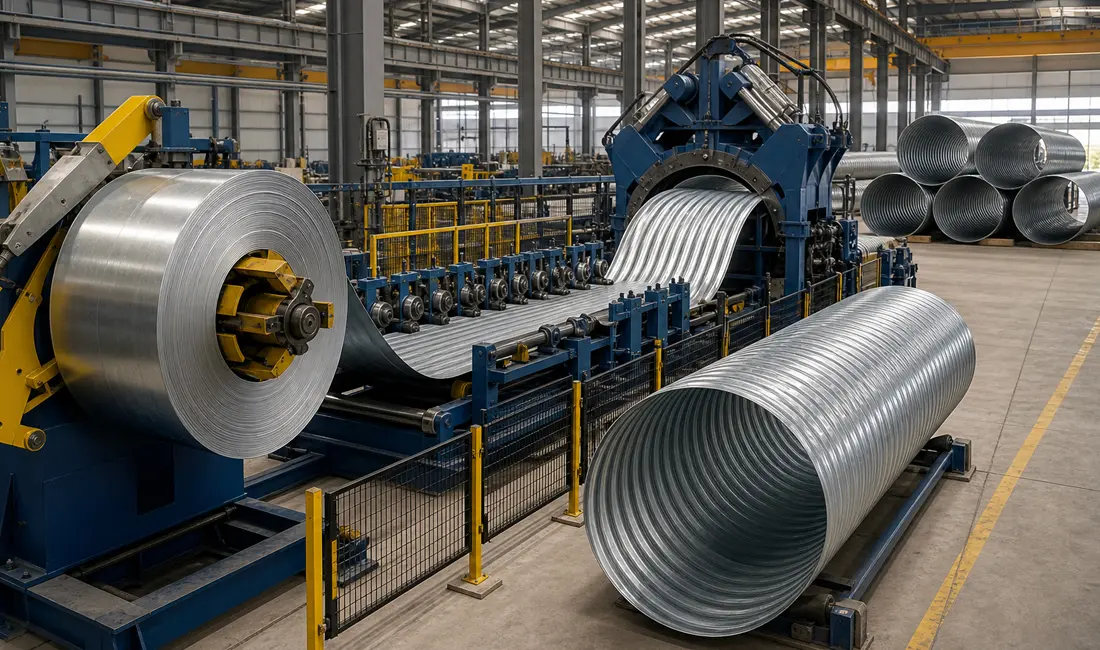
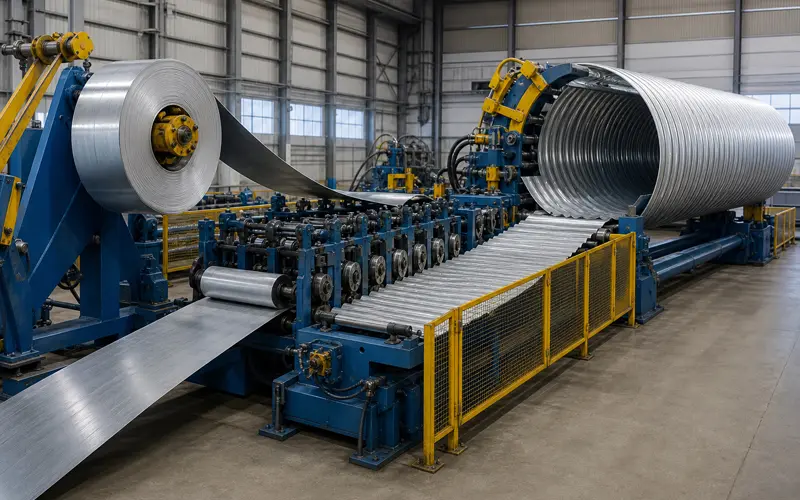
Spiral corrugated culvert pipe production moves through four main steps. These are decoiling, corrugating, spiral forming with seam locking, and cutting to length. Decoiling unwinds the flat steel strip and feeds it into the line at a steady rate. Corrugating presses the wave pattern into the strip. Spiral forming winds the corrugated strip into a tube shape. It locks each wrap to the one before it. Cutting trims the tube into finished pipe lengths. Each step depends on the one before it. A problem early on, like uneven strip feed, tends to show up later as a weak wave depth or a loose seam.
Steel coil becomes spiral corrugated culvert pipe through one continuous forming line. This line shapes, winds, and locks the strip into a finished tube without stopping between steps. The sections below walk through this sequence in the order it happens on the shop floor.
Decoiling starts the process by unwinding steel strip from a coil and feeding it into the line at a controlled speed. A vertical decoiler holds the coil upright. It lets the strip unwind smoothly without twisting or scratching the coating. Steady feed speed matters here. Uneven feeding can throw off the corrugation depth or spiral pitch further down the line. On BOBO’s spiral corrugated culvert pipe machine, a vertical decoiler feeds galvanized strip from 2mm to 3mm thick. The line supports continuous runs at speeds up to 20 meters per minute.
Steel strip is corrugated by passing it through shaped rollers. These rollers press a repeating wave pattern into the flat metal before it winds into pipe form. The rollers squeeze the strip between matching ridges and grooves. This stretches the metal into a consistent wave shape along its full length. The depth and spacing of this wave, called the corrugation profile, sets how much load the finished pipe can carry under soil and traffic. A deeper, tighter corrugation profile usually gives the pipe more stiffness. This matters most for larger pipe carrying heavier loads.
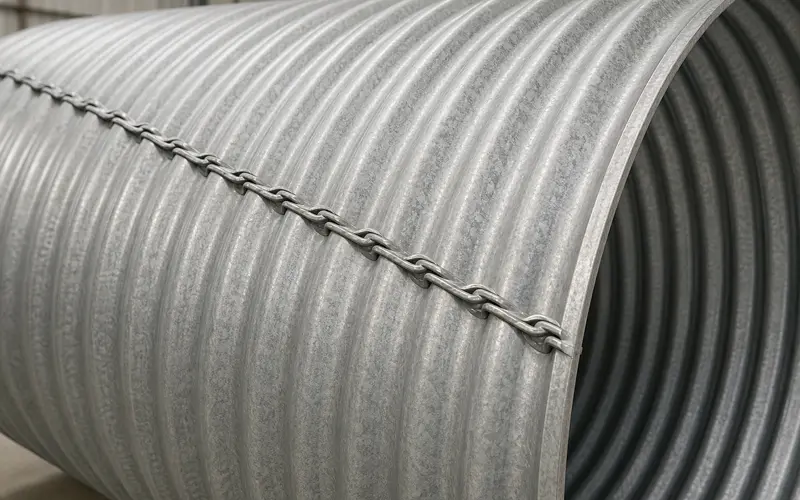
Spiral seams lock together through a mechanical fold. This fold interlocks the edges of the corrugated strip as it winds into a helical tube. As the strip feeds off the corrugating rollers, a forming head winds it around at a set angle. Each new wrap overlaps the edge of the wrap before it. A seaming roller then folds and crimps these edges into a tight mechanical lock. This lock seam runs continuously along the full length of the pipe. It gives the pipe consistent strength and keeps soil or water from working through the joint. BOBO’s machine uses this method to produce pipe from 600mm to 3600mm in diameter on one line.
Spiral corrugated culvert pipe quality is judged by three things: dimensional tolerance, coating thickness, and compliance with industry standards. These checks confirm the pipe holds its shape and resists corrosion once it goes into the ground.
Diameter and corrugation tolerances matter because an out-of-round or undersized pipe can leave gaps at the joints. It can also lose strength under load. Common practice sets finished pipe diameter tolerance at about one inch or two percent of nominal diameter, whichever is larger. Manufacturers check corrugation depth and pitch against the spec at regular intervals during a run. A shift in either measurement changes how the pipe carries load once it is buried.
Coating standards protect culvert pipe from corrosion by setting minimum thickness for the zinc or polymer layer on the steel. Standard practice for galvanized pipe targets a zinc coating around 610 grams per square meter across both surfaces. Polymer-coated pipe typically adds a 10-mil layer on each side over the zinc base. This extends service life in aggressive soil or wastewater conditions. Manufacturers should confirm actual coating weight through periodic sampling, not just the coil supplier’s certification.
AASHTO and ASTM publish the main standards for spiral corrugated culvert pipe in North America. AASHTO M218 covers zinc-coated steel sheet used for corrugated steel pipe. AASHTO M36 covers the finished galvanized pipe. ASTM A760 sets broader material and dimensional rules for corrugated steel pipe. Highway, railway, and municipal drainage specs typically reference one or more of these standards. Production processes need to prove they meet the referenced requirements.
Spiral corrugated culvert pipe equipment needs to match the diameter range, strip thickness, and output speed a manufacturer actually needs. Three factors decide which machine fits: diameter and thickness capacity, the ability to run multiple diameters on one line, and production speed.
Match a machine’s diameter range and strip thickness capacity to the pipe sizes a manufacturer’s projects call for. Running outside that range means adding a second machine. BOBO’s spiral corrugated culvert pipe machine forms pipe from 600mm to 3600mm in diameter using strip from 2mm to 3mm thick. This covers drainage culverts, foundation pit casings, and large-diameter post-tension duct work from one machine.
Consider whether one line can switch between diameters without a full retooling process. Many drainage and infrastructure projects need a range of pipe sizes, not one fixed diameter. BOBO’s machine adjusts forming settings through a PLC touch screen. Operators switch diameters across the full range without swapping dedicated tooling for each size. This cuts the capital cost of running several separate machines.
Evaluate a machine’s rated speed and automation level against the output volume a manufacturer needs. BOBO’s machine runs a motorized-hydraulic hybrid drive. It supports continuous speeds up to 20 meters per minute on a 10-ton frame. This combination supports steady output on large infrastructure orders without frequent downtime.
Spiral corrugated pipe is formed by winding a continuous strip into a helical shape. One long seam runs around the pipe like a screw thread. Annular corrugated pipe is formed with separate, closed rings running straight across the pipe instead. Spiral pipe production runs continuously from coil stock, which suits long runs and larger diameters. Annular pipe often comes in structural plate sections bolted together on site. This suits very large culverts or pipe-arch shapes.
Many modern spiral forming lines can produce a wide diameter range on one machine by adjusting settings, not swapping tooling. A PLC-controlled system lets operators dial in a new diameter from a touch screen. This replaces manually resetting rollers or dies. Checking a machine’s rated diameter range against a project’s full product mix confirms whether it covers every size.
Uneven corrugation depth usually traces back to inconsistent strip feed speed or worn forming rollers. A decoiler that feeds strip unevenly can starve the corrugating rollers of steady tension. This shows up as shallow or irregular waves in the finished profile. Regular checks on roller wear and feed tension catch this problem before it affects a full run.
Spiral corrugated culvert pipe starts as a flat coil of steel. It becomes a finished pipe through four steps. These are decoiling, corrugating, spiral forming, and seam locking. Each step matters. Together, they decide if the pipe holds up under soil pressure. They also decide if it resists corrosion for decades. The right equipment matters too. It should match the diameter range, strip thickness, and output speed a project needs. This helps a manufacturer meet AASHTO and ASTM standards on every run. BOBO Machine builds spiral corrugated pipe forming equipment. This equipment serves culvert, drainage, and post-tension duct production. Contact BOBO Machine to find the right pipe forming equipment for a production line.