Tube bending fails when manufacturers pick the wrong internal support method. Mandrel bending uses a solid rod inside the tube to stop it from collapsing during tight bends. Mandrel-less bending skips that rod and works best on thicker tubes with larger bend radii. The right choice affects part quality, cost, and whether a bend meets spec.
The decision comes down to wall thickness, bend radius, and material. A thin-walled tube needs a mandrel for a tight bend. Without one, it will wrinkle or collapse. The same tube bent to a gentle curve may not need one at all.
This guide compares both methods, explains which tube parameters call for mandrel support, and covers when each method fits a given production run.
What Is the Difference Between Mandrel Tube Bending and Mandrel-less Tube Bending?
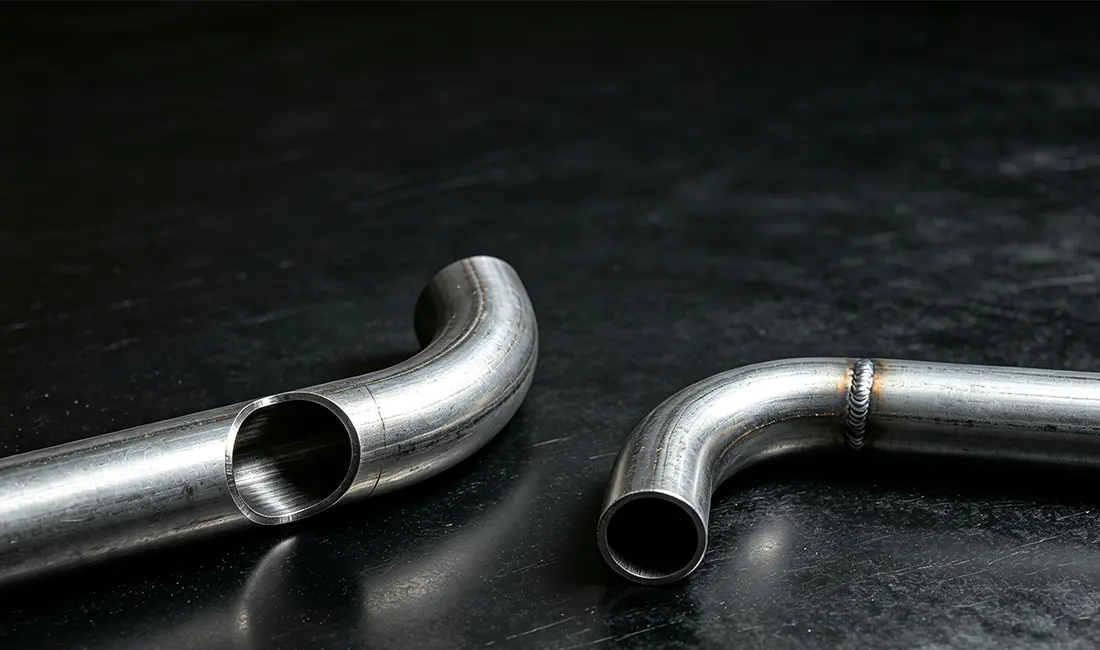
The main difference is internal support. Mandrel bending uses a solid rod inside the tube to prevent collapse. Mandrel-less bending has no internal support and relies on the tube’s own strength.
What Is Mandrel Tube Bending?
Mandrel tube bending inserts a solid metal rod inside the tube during the bend. This rod supports the inner wall and stops the tube from collapsing or wrinkling.
The mandrel stays in place as the tube bends around a die. It pushes back against the compression forces on the inside of the bend. This keeps the tube round and keeps the wall thickness even.
Manufacturers use this method for tight-radius bends and thin-walled tubes. It works best when the diameter-to-wall-thickness ratio is above 25:1. These thin tubes cannot hold their shape on their own.
What Is Mandrel-less Tube Bending?
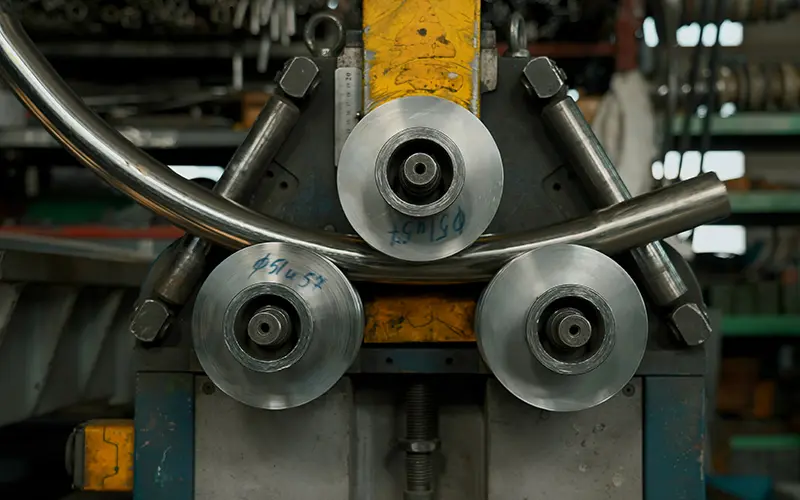
Mandrel-less tube bending bends the tube around a die with no internal support. The tube relies on its own wall strength to hold its shape.
This method suits tubes with thick walls and large bend radii. It also costs less and sets up faster, since there is no mandrel to insert or remove.
On tight bends, though, the inner wall can flatten and the wall thickness can turn uneven. This limits mandrel-less bending to jobs where minor deformation is acceptable.
What Are the Pros and Cons of Mandrel Bending Compared to Mandrel-less Bending?
Mandrel bending keeps tube shape steady but costs more to set up. Mandrel-less bending sets up fast and costs less, but risks deforming the tube. The right choice depends on bend radius, wall thickness, and production volume.
Pros and Cons of Mandrel Tube Bending
A mandrel supports the tube from the inside, which keeps wall thickness even and produces smooth, wrinkle-free bends.
Advantages:
- Minimal wall thinning or distortion
- Handles tight bend radii without crushing the tube
- Works well with thin walls (under 0.065 inches)
- Leaves a smooth interior that needs no extra finishing
- Lowers scrap rates through accurate first bends
Disadvantages:
- Needs specialized mandrel tooling, which raises setup cost
- Takes longer to set up between tube sizes
- May leave faint marks inside the tube
- Runs slower than mandrel-less methods
- Needs regular mandrel maintenance
Pros and Cons of Mandrel-less Tube Bending
Mandrel-less bending shapes the tube around a die with no internal support, relying on the tube’s own wall strength.
Advantages:
- Costs less, with simpler tooling
- Allows fast changeovers between tube sizes
- Works well for large bend radii (4 times the tube diameter or more)
- Cuts tooling wear and maintenance
- Shortens lead times for small runs
Disadvantages:
- Wrinkles or flattens on tight-radius bends
- Produces uneven wall thickness along the bend
- Raises scrap rates, especially on thin walls
- Limits precision for tight-tolerance parts
- Leaves a rougher interior that may need finishing
How Do the Two Methods Compare on Key Production Factors?
| Factor | Mandrel Bending | Mandrel-less Bending |
| Minimum Bend Radius | 1.5× tube diameter | 4× tube diameter |
| Setup Cost | 5,000−5,000-5,000−15,000 per mandrel | 500−500-500−2,000 per die |
| Setup Time | 30-60 minutes | 10-15 minutes |
| Wall Thickness Range | 0.020-0.250 inches | 0.065-0.500 inches |
| Scrap Rate | 2-5% | 8-15% |
Mandrel bending suits high-volume runs where bend quality is worth the setup cost. Mandrel-less bending suits prototypes or gentle bends where deformation risk is low. Tubes under 0.065 inches wall thickness need a mandrel to avoid collapse.
Which Tube Parameters Determine Whether Mandrel Support Is Needed?
Wall thickness, bend radius, and material determine whether a tube needs a mandrel. Thin tubes bent to a tight radius need one. Thick tubes bent to a gentle radius often don’t.
Wall Thickness and Bend Radius Together
Two numbers drive this decision. The first is the wall factor. This is the tube’s outer diameter divided by its wall thickness. Some shops call it the D/t ratio.
The second number is the D of bend. This is the centerline radius divided by the outer diameter. This guide calls the same number “3D” or “4D” elsewhere.
These two numbers work together. A wall factor below 15 and a D of bend above 6 usually need no mandrel at all. A wall factor above 25 always needs one, even on a gentle bend. Between those points, check the actual bend radius before you skip the mandrel.
Role of Tube Material and Surface Quality
Stainless steel, titanium, copper-nickel, and T6 aluminum wrinkle more easily than mild steel. These materials need firmer mandrel support. High-nickel stainless steel (314, 329) and nickel alloys like Inconel can deform more before they collapse. These materials need less aggressive mandrel setups.
Surface quality matters too. Rough tube surfaces create more friction against the tooling, which can cause marking or distortion. Smooth, clean tubes bend more predictably and can use a slightly looser mandrel fit.
Can a Tube Still Wrinkle Even When a Mandrel Is Used?
Yes. Wrinkles form in two common cases. The mandrel may sit too far back from the tangent point. Or the nose diameter may be too small. Either error lets the tube’s inner wall buckle before the mandrel can support it.
Common setup errors that cause wrinkling:
- Mandrel positioned more than 0.020 inches behind the tangent point
- Nose diameter smaller than (OD − WT × 2.21)
- Too few balls for the wall factor
- Worn mandrel balls that create flat spots
Bend angles beyond 180 degrees raise the risk too. The tube spends more time under stress, which can overwhelm the mandrel’s support.
When Should Manufacturers Choose Mandrel Bending Versus Mandrel-less Bending?
The choice depends on wall thickness, bend radius, and the finish quality a part needs. Matching these three factors to the right method up front saves rework and scrap later.
Choose Mandrel Bending When Tubes Have Thin Walls or Tight Radii
Mandrel bending fits thin tubes and tight bends. Below 3 times the tube diameter (3D), the risk of wrinkling rises fast without internal support.
Applications requiring mandrel bending:
- Exhaust systems in automotive manufacturing
- Aerospace tubing with precise tolerances
- Medical device components
- Hydraulic lines with thin walls
- Roll cages and structural frames
This method fits tubes under 0.065 inches wall thickness. Stainless steel needs it more often than other materials, since it wrinkles easily.
Choose Mandrel-less Bending When Tubes Have Thick Walls or Gentle Radii
Mandrel-less bending fits thick tubes and gentle bends. Tubes over 0.125 inches wall thickness usually resist collapse on their own, especially above 4 times the tube diameter (4D).
Applications using mandrel-less bending:
- Construction scaffolding
- Furniture frames
- Basic plumbing systems
- Agricultural equipment
- Low-pressure fluid lines
This method also fits prototypes and small batches, since setup takes minutes instead of hours. Minor cosmetic deformation is often acceptable in these jobs.
What Should Manufacturers Check Before Selecting a Bending Method?
Wall thickness, bend radius, and part tolerance all affect this decision.
The D/t ratio (outer diameter divided by wall thickness) is a fast way to check. A ratio above 25 usually needs a mandrel. A ratio below 15 usually doesn’t. Ratios in between call for a closer look at the actual bend radius.
Key factors for method selection:
| Factor | Mandrel Needed | Mandrel-less OK |
| Bend radius | Under 3D | Above 4D |
| Wall thickness | Under 0.065″ | Above 0.125″ |
| D/t ratio | Above 25 | Below 15 |
| Surface finish | Critical | Flexible |
Production volume matters too. Mandrel setups cost more upfront but cut scrap in long runs. Parts that need ±0.5 degrees of angular accuracy also need mandrel support. This keeps the tolerance steady.
BOBO’s mandrel tube bender supports the tube wall through the full bend cycle. This keeps wall thickness steady on tight-radius work like exhaust systems and roll cages. For thicker tubes and gentler bends, BOBO’s CNC tube bending machine handles mandrel-less setups on the same production line, which cuts changeover time between tube sizes.
Frequently Asked Questions
How can I tell which failure mode a tube is at risk of without a mandrel?
A tube without enough support tends to fail one of two ways. Thin tubes usually collapse or flatten along the inside of the bend. Tubes with more wall thickness tend to wrinkle instead, buckling in small ripples on the inner radius. Either sign points to the same fix: add mandrel support, or open up the bend radius.
What tubing sizes and wall thicknesses can a mandrel tube bender handle?
Mandrel tube benders typically handle tubes from 0.25 to 6 inches in diameter. Wall thickness usually ranges from 0.020 to 0.250 inches. Tubes under 0.065 inches usually need a mandrel to avoid collapse. Tubes over 0.125 inches often don’t, since the wall alone can resist deformation. A D/t ratio above 25:1 is a reliable sign that a mandrel is needed.
How do bend radius and material affect this choice?
Bends tighter than 3D need mandrel support. The inside of the bend faces more stress at this radius. Bends looser than 4D can often skip the mandrel. This works as long as the wall is thick enough on its own.
Soft materials like aluminum and copper collapse easily, so they usually need a mandrel. Harder materials like stainless steel and titanium resist deformation better, but tight bends in these materials still need one.
Conclusion
The choice between mandrel and mandrel-less bending comes down to wall thickness, bend radius, and material. Thin walls, tight bends under 3D, and materials prone to wrinkling call for a mandrel. Thick walls, gentle bends above 4D, and forgiving tolerances make mandrel-less bending the faster, cheaper option. BOBO Machine builds both mandrel tube benders and mandrel-less setups. These fit production lines that switch between tight and gentle bends. Contact BOBO Machine to match the right method to a specific tube spec.