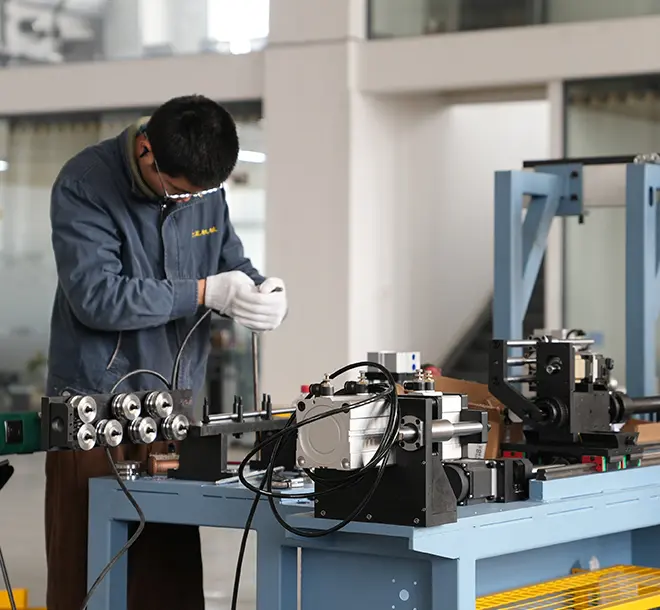
Springback Compensation in CNC Tube Bending: Key Methods and Choices
Jump to section
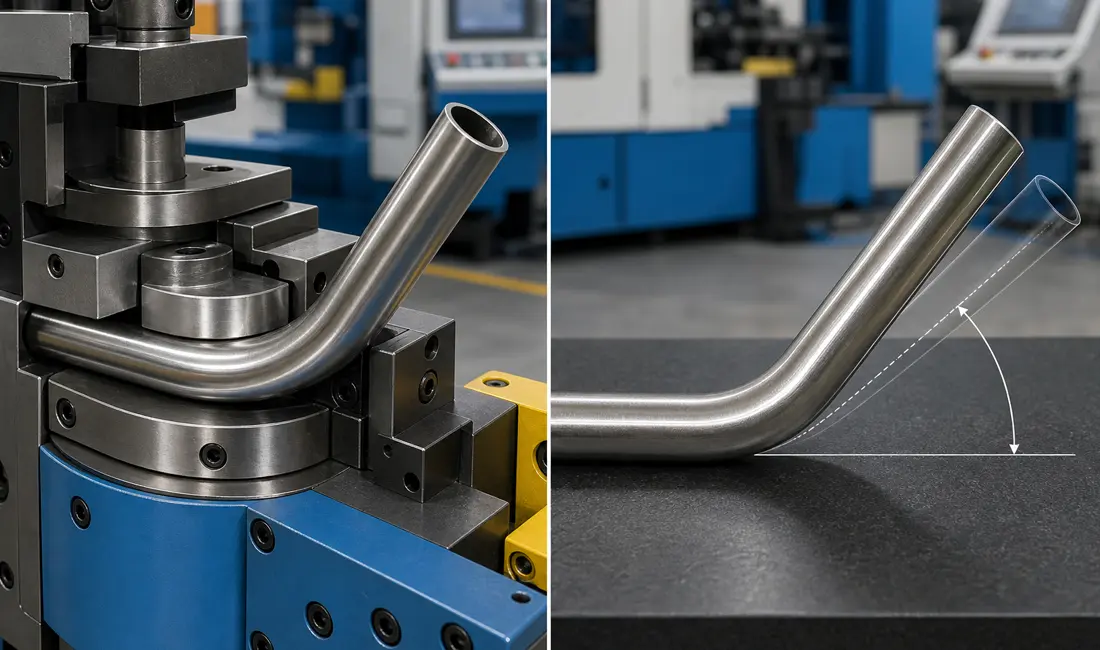
Springback compensation decides whether a CNC tube bending project meets tolerance or turns into scrap. When bending forces release, tubes undergo elastic recovery. This opens the bend angle. It also increases the radius. Springback varies by material. Stainless steel can spring back 5-7 degrees. Copper alloys barely move. Accurate compensation is essential for good first-pass results.
Modern CNC tube benders use a few main methods to handle springback. Overbending pushes the tube past the target angle. Tooling can also control material flow during the bend. Software can predict the springback before production even starts. The right choice depends on material, bend geometry, tolerance, and production volume.
This guide covers how springback happens and what affects its size. It also covers how to pick the right compensation method, plus the practical steps for putting compensation into practice.
Springback is the elastic recovery that causes a bent tube to open back toward its original shape. This happens once bending forces are removed. The outer surface stretches under tension. The inner surface compresses. When tooling releases the tube, the elastic part of this deformation reverses itself.
Tube bending creates both plastic and elastic deformation. The outer wall, or extrados, stretches under tension. The inner wall, or intrados, compresses. Plastic deformation permanently reshapes the tube. Elastic deformation just stores energy in the material instead.
When the bending die releases the tube, that stored energy lets go. The bend angle opens. The radius grows. How much depends on the ratio between the material’s yield strength and its elastic modulus.
High-strength materials spring back more. They resist plastic deformation while keeping their elastic properties. Stainless steel 304 and 316 spring back 5 to 7 degrees. Mild steel shows moderate springback that rises with yield strength. Copper alloys need minimal compensation, thanks to their high ductility.
Geometry also plays a role. Tight-radius bends create more strain and more elastic recovery. A tight radius means a centerline radius below 2 times the diameter. Thin-walled tubes behave unpredictably without mandrel support. Bend angles past 90 degrees build up more total springback.
Springback measurement compares the final bend angle to the die angle used during forming. The gap between the two numbers is the elastic recovery. CNC systems with built-in angle sensors can measure this in real time. This happens during the bending cycle itself.
Post-bending checks often use coordinate measuring machines, or CMMs. These suit first-article checks and capability studies. Laser scanning can also capture millions of data points across the full bend profile, in just seconds. The table below shows typical accuracy for each method.
| Method | Accuracy | Best Use |
| Real-time angle sensors | ±0.05 to 0.15° | Closed-loop compensation during bending |
| CMM inspection | ±0.05 to 0.15° | First-article and capability studies |
| Laser scanning | ±0.10 to 0.25 mm | Complex geometries and full profiles |
| Go/no-go fixtures | Pass/fail at tolerance | High-volume production verification |
Shop floors often use go/no-go fixtures for a quick pass/fail check. These match the design tolerance directly, without a detailed measurement. Statistical process control tracks angle measurements over time. This helps catch tool wear or material shifts before parts fall out of tolerance.
Material properties, bend geometry, and temperature all shape the amount of springback. Higher yield strength and smaller bend radii increase it. Higher temperature reduces it.
Materials with higher yield strength produce more springback. They store more elastic energy while bending. The elastic modulus sets how much a material springs back once the stress is removed.
Steel with a 400 MPa yield strength springs back about 2-4 degrees on a 90-degree bend. Aluminum at 200 MPa yield strength springs back only 1-2 degrees under the same setup. The ratio of yield strength to elastic modulus predicts springback better than either number alone.
Stainless steel needs 15-20% more compensation than mild steel. Titanium alloys need 25-30% more. This comes from their high strength-to-modulus ratio.
Smaller bend radii create higher stress. This increases springback. A tube bent to 1.5 times its diameter springs back more. A tube bent to 3 times its diameter springs back less.
The ratio of bend radius to tube diameter, or R/D, controls this directly. Tubes with an R/D below 2.0 show springback 40-60% higher than tubes above 3.0.
Wall thickness matters too. It affects the neutral axis position during the bend. Tubes with walls under 10% of the outside diameter show 30-50% more springback than thick-walled tubes. The outer fibers stretch. The inner fibers compress. This creates the residual stress behind the recovery.
Tight bends combined with thin walls create the worst springback conditions. Operators should add 3-5 extra degrees of compensation for this combination.
Yes. Higher forming temperature lowers the material’s yield strength and elastic modulus. This reduces springback. Most metals grow more ductile and less elastic as they heat up.
Room-temperature steel bending produces springback of 2-4 degrees. Heating to 200°C cuts that to 1-2 degrees. At 400°C, springback drops below 1 degree. The material now deforms more plastically and recovers less.
The right temperature varies by material. Aluminum alloys show a notable drop at 150-200°C. Stainless steel needs 300-400°C for a meaningful change. Titanium benefits most from hot forming at 600-800°C. Springback falls by 70-80% at that range.
Cold forming stays standard for most work, since heating adds cost. Hot bending suits high-strength materials where cold compensation alone cannot hit tolerance.
CNC tube bending relies on three main compensation methods. Manual overbending draws on operator experience. Automated compensation uses pre-programmed CNC data. Closed-loop systems use real-time feedback.
Manual overbending is a method where operators bend past the target angle by a set amount. This amount is based on measured springback. The operator runs a test bend, measures the springback, and programs the machine to overbend by that amount.
Stainless steel 304 typically needs 5-7 degrees of overbending. Mild steel needs 2-4 degrees.
Manual overbending limitations:
Manual methods cannot hold tolerances tighter than ±0.5 degrees consistently. High-volume or high-precision work needs a more automated approach.
Automated compensation is a method that stores material-specific springback data right in the CNC controller. The machine applies correction factors on its own. It bases this on material, wall thickness, bend radius, and bend angle.
Operators just select a material profile from a stored library. The machine adjusts itself from there. This cuts setup time by 40-60% compared to manual methods. BOBO’s CNC pneumatic 3D tube bender works this way. Its controller calculates springback compensation and positions each bending axis on its own. This means the finished tube matches the programmed profile without manual adjustment. The controller stores up to 900 bending programs across three machine sizes. These cover tube diameters from 12.7mm to 40mm.
Automated systems reach ±0.15 to ±0.30 degrees of repeatability, when the material matches the stored data. Batch-to-batch shifts in yield strength can still cause deviations. It helps to check material certificates for each lot.
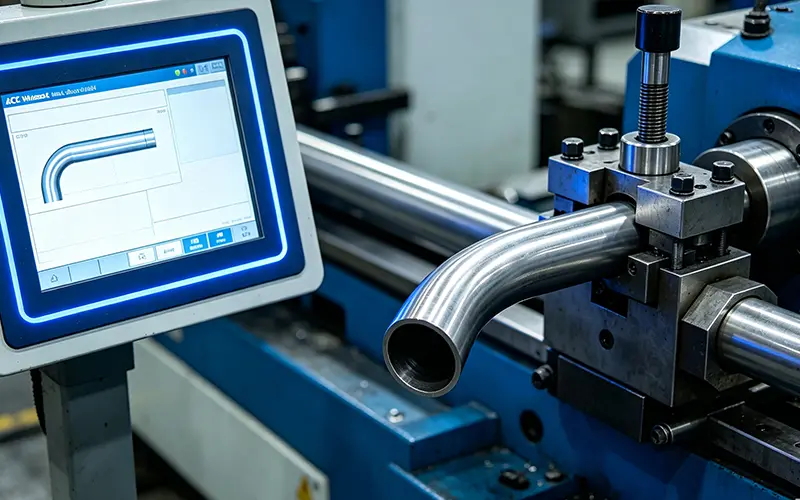
Closed-loop compensation is a method that measures the real bend angle. It does this during, or right after, bending, using built-in sensors. The CNC compares that measured angle to the target. It adjusts the next bend on its own.
Springback that causes deviation gets corrected automatically. This happens on the very next part, with no operator input needed.
Closed-loop systems reach ±0.05 to ±0.15 degrees of accuracy. This meets tight tolerances in precision HVAC parts and automotive fuel-line or brake-line work. Manual or basic automated methods fall short here.
Real-time monitoring also cuts labor waste from manual rework. Scrap rates drop from 10% to under 2%. Flaws get caught and fixed right away. The system adapts to tool wear and material shifts on its own.
All-electric CNC benders with closed-loop control cost more upfront than pneumatic or manual setups. That extra cost often pays back through less waste. It also opens access to tight-tolerance, higher-margin work.
The right method depends on volume, tolerance, and material. Manual overbending works for simple parts with loose tolerances. Automated systems become necessary once precision must stay within 0.3°. The same is true once volume tops 100 parts a month.
Manual overbending gives reliable results for tolerances of ±0.5° to ±1.0°. With careful setup, it can still work down to about ±0.3°. It suits runs below 50 parts per month. Setup time costs less than a full automated system at this volume.
Predictable materials make manual compensation practical. Mild steel and soft copper alloys stay steady within 2-3° across batches. This lets operators build reliable overbend factors through trial runs.
Ideal applications for manual overbending:
Manual methods fail once part complexity rises or tolerances tighten below ±0.3°. Wall thinning and batch-to-batch material shifts create springback that manual adjustment cannot correct fast enough.
Automated compensation becomes necessary once tolerances tighten past ±0.3°. All-electric CNC benders with closed-loop systems measure bend angles in real time. They adjust overbend on their own. These systems reach ±0.05° to ±0.15° repeatability.
High-springback materials need this level of control. 304 and 316 stainless steel show 5-7° of springback with notable batch shifts. Closed-loop systems adapt to this automatically. This cuts scrap rates from 10% to under 2%.
Critical scenarios requiring automation:
FEA software can also plug into automated systems for complex shapes. It simulates springback before production. It sends the values straight into the CNC program. This cuts out the trial-and-error cycle entirely.
Start with a first-article check to confirm compensation accuracy before a full run. Measure the first bent part with a CMM. Check it against the angular and positional tolerances in the design spec. Record these numbers as a baseline.
Next, run a pilot batch of 5-10 parts and inspect each one. Calculate the standard deviation of the bend angles. Below 0.1° shows stable process control. Above 0.2° points to a tooling or material issue.
Verification checklist:
Lock in the settings once three parts in a row meet tolerance without further adjustment.
Yes. Each bend on a multi-bend tube can shift the tube slightly. Springback errors can then stack up across the part. Parts with four or more bends often need tighter per-bend compensation. This keeps the final shape within tolerance.
Under-compensation leaves the bend angle too open. Over-compensation closes it too far. Either way, the part falls out of tolerance. This leads to scrap or rework. A first-article check catches this before a full run.
Not reliably. Yield strength can shift from batch to batch, even within the same material spec. That shift changes the springback angle too. Checking the mill certificate for each new batch confirms whether the old settings still apply.
Springback compensation turns a predictable material property into a controllable part of CNC tube bending. Manual overbending works for simple, low-volume parts with loose tolerances. Automated compensation applies stored material data on its own once tolerances tighten. Closed-loop systems add real-time feedback for the tightest tolerances and highest-volume work. Matching the method to material, geometry, tolerance, and volume keeps scrap rates low. It also keeps first-pass yield high. BOBO Machine builds CNC tube benders with built-in springback compensation for HVAC, refrigeration, and automotive tube production. Contact BOBO Machine to match the right tube bending equipment to a production line.