Stainless Steel Bellows Production: Hydroforming vs Roll Forming
Jump to section
A stainless steel bellows lives a hard life. It flexes thousands of times. It absorbs vibration. It often seals against high pressure or heat. The forming method used to make it decides if it survives that life or fails early. Hydroforming and roll forming are the two main ways to shape stainless steel tube into a bellows. This guide explains how each method works. It covers where they differ. It also covers which one fits a given production run.
Stainless steel bellows production is a process that shapes stainless steel tube into a flexible, corrugated wall. This wall expands and contracts under pressure, vibration, or heat. The wavy wall acts like a spring. It lets the bellows absorb motion while it still holds a seal. The forming method creates these waves, called convolutions. This method sets the wall thickness, the fatigue life, and the cost of the finished part.
Manufacturers most often use 304 and 316L stainless steel for bellows. 304 stainless steel gives good general corrosion resistance at a lower cost. 316L stainless steel adds molybdenum. This improves resistance to chlorides and harsh chemicals. Some high-heat or high-cycle jobs need nickel alloys such as Inconel. These alloys hold up better under repeated flexing at extreme heat. The right material depends on three things: the fluid inside the system, the operating temperature, and how many flex cycles the bellows must survive.
The forming method controls how much the metal stretches and thins as it takes its wavy shape. Every forming process thins the tube wall at the peak of each wave. The metal must stretch to form the wave. A method that thins the wall evenly gives the bellows even strength all the way around. A method that thins one spot more than another creates a weak point. That weak point is usually where the bellows cracks first. Fatigue life is how many flex cycles a bellows can survive before it fails. This life depends directly on how even the thinning turns out.
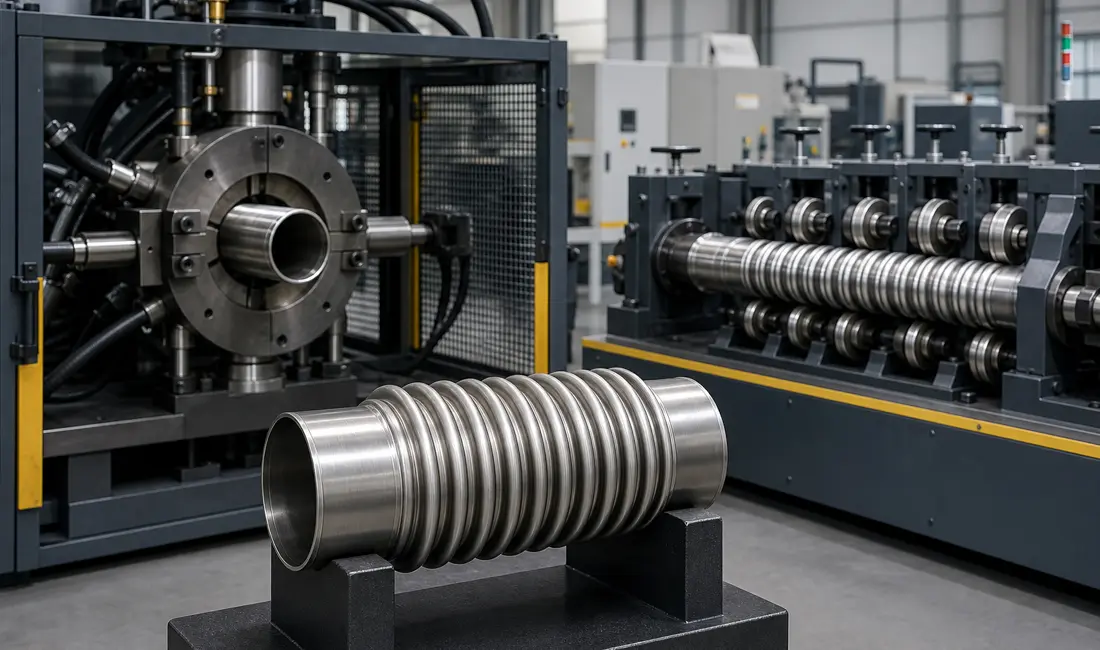
Hydroforming and roll forming are the two main methods for turning straight stainless steel tube into a bellows. Both start with a welded or seamless tube. Both end with a finished wave pattern. But they reach that result in very different ways.
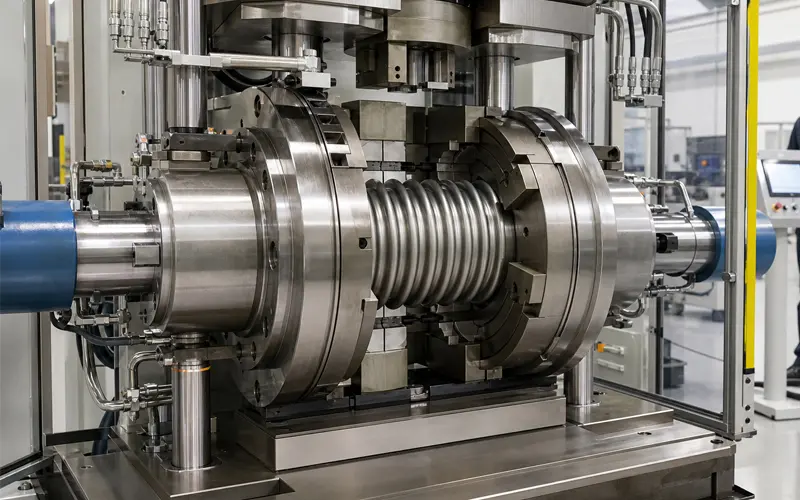
Hydroforming is a bellows forming method that uses pressurized fluid inside a sealed tube. This fluid pushes the metal outward into a die around the tube. The operator places the tube inside a split die shaped with the target wave pattern. Fluid, usually an emulsion or oil-water mix, fills the tube and builds pressure. As pressure rises, the tube wall expands to match the die shape. The dies close in stages to form each wave in order. This process forms every wave from a single piece of tube. The shape comes from pressure inside, not rolling outside. So there are no seams between waves.
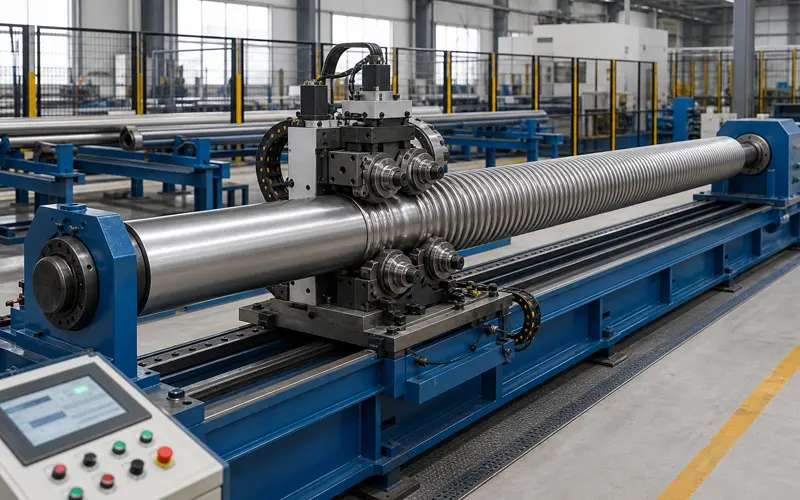
Roll forming is a bellows forming method that uses outside rollers to press each wave into the tube wall. The tube mounts on a rotating spindle. Shaped rollers press inward as the tube spins. The rollers move along the tube length. They form one wave at a time in a steady rolling motion. This method needs no pressurized fluid system. That makes the equipment simpler than hydroforming.
Hydroforming and roll forming differ most in three ways: wall thickness, wave accuracy, and production speed. These factors decide which method suits a given bellows design and order size.
Hydroforming usually gives more even wall thinning than roll forming. Internal fluid pressure pushes against the whole tube surface at once. This even pressure spreads the stretching across the full circle of each wave. Roll forming applies force at one rolling contact point. This can create uneven thinning if the roller pressure or feed speed is not tightly controlled. Manufacturers making bellows for high-pressure or high-cycle use often choose hydroforming for this reason. Even wall thickness supports a longer fatigue life.
Hydroforming copies the exact wave shape cut into the die. This gives very consistent wave geometry across a full production run. The die controls the shape. This makes complex or unusual wave profiles easy to form. Roll forming depends on precise roller alignment and steady tube feed speed. Both must stay consistent to keep every wave the same size. Roll forming tooling also tends to be simpler and cheaper than a full hydroforming die set. It uses shaped rollers instead of a custom-machined die for each bellows size.
Roll forming often runs faster for long, simple wave patterns. The rollers move continuously along the tube. They do not need to build up pressure between cycles. Hydroforming needs time to fill the tube with fluid and build pressure for each stage. This can slow cycle time on very long bellows. On tooling cost, roll forming usually costs less to set up for one diameter and wave pattern. Hydroforming die sets cost more upfront. But the same press can often produce many different bellows designs by swapping dies. This spreads that cost across a wider range of products.
The table below sums up these tradeoffs across all three factors.
| Factor | Hydroforming | Roll Forming |
| Wall thickness consistency | More even, supports longer fatigue life | Can vary with roller pressure and feed control |
| Convolution accuracy | Very consistent, handles complex profiles | Depends on roller alignment and tube feed speed |
| Tooling cost | Higher upfront, reusable across designs | Lower upfront, simpler tooling |
| Production speed | Slower per cycle on long bellows | Faster for long, simple wave patterns |
| Best suited for | High-pressure, high-cycle, or complex profiles | Standard profiles at higher volume |
Choosing between hydroforming and roll forming comes down to three factors. These are bellows diameter and wall thickness, production volume, and how complex the wave profile needs to be.
Larger diameters and thicker walls usually favor hydroforming. Even internal pressure handles thick material more reliably than outside rolling contact. Thin-wall, small-diameter bellows can run well on either method. This shifts the decision toward volume and cost instead. High volume of one standard design often favors roll forming. Its lower tooling cost pays off faster across many identical parts. Low volume or frequently changing designs often favor hydroforming. One die set or press can adapt to different profiles with less retooling.
Hydroforming is the right choice for complex, irregular, or high-cycle bellows shapes. Even wall thickness and precise wave geometry matter most here. Aerospace expansion joints, precision instrument bellows, and high-pressure piping compensators often use hydroforming for this reason. BOBO’s hydraulic bellows expansion joint forming machine uses this pressurized-fluid method. It forms stainless steel bellows across a diameter range of DN100mm to DN6000mm. PLC-controlled die separation completes a full forming cycle in about four minutes.
Roll forming is the right choice for high-volume production of standard, repeatable wave patterns. Tooling cost and cycle speed matter more here than handling complex shapes. Common examples include standard pipe expansion joints, HVAC ducting bellows, and general industrial compensators made in large batches. Roll forming tooling costs less to set up for one wave pattern. So it often delivers a lower cost per part once volume climbs high enough.
Multi-ply bellows are bellows that nest two or more thin-wall layers together for extra strength. Manufacturers can form these layers with either hydroforming or roll forming. They typically form each layer separately. Then they nest the layers together before final assembly. Hydroforming often suits multi-ply construction well. Even pressure helps keep each thin layer’s wall thickness consistent.
Welding usually happens before and after the forming stage, not during it. Manufacturers first weld flat stainless steel sheet into a tube. Most bellows start from welded stock rather than seamless stock. After forming, welders attach end fittings, flanges, or reinforcing collars. This completes the finished assembly.
Very large diameters tend to favor hydroforming. Even internal pressure scales more predictably than outside roller contact as tube size grows. Very small diameters can be harder for roll forming tooling to grip and control. A machine’s rated diameter range should match the target bellows size to confirm compatibility.
Hydroforming and roll forming both turn straight stainless steel tube into a working bellows. But they reach that result differently. Hydroforming uses internal fluid pressure. This gives even wall thickness and precise, repeatable waves. Roll forming uses outside rollers. This gives faster, lower-cost production of standard wave patterns at high volume. The right choice depends on diameter, wall thickness, production volume, and wave complexity. BOBO Machine builds hydraulic bellows expansion joint forming equipment for stainless steel bellows production. Contact BOBO Machine to match the right forming equipment to a bellows production line.