PU Elastomer Casting: Wheel, Roller & Industrial Part Production
Jump to section
Industrial wheels, coated rollers, and wear parts carry heavy loads every day. Rubber often wears out too fast under that load. Cast polyurethane lasts longer and carries more weight in a thinner section. That is why more plants now cast these parts in house instead of buying them finished. This article covers the process stages, the differences between part types, the machine variables that control quality, and how to specify a machine.
PU elastomer casting is a liquid moulding process that mixes a heated prepolymer with a curative and pours the blend into a mould, where it cures into a tough elastomer. Wheels and rollers depend on it for load capacity, wear life, and bond strength.
The prepolymer is a urethane intermediate that carries reactive isocyanate end groups. The curative is a chain extender that links those chains into a solid network. Common curatives include MOCA, 1,4-butanediol, and HQEE. The mix stays liquid for a few minutes, then gels and hardens inside the mould.
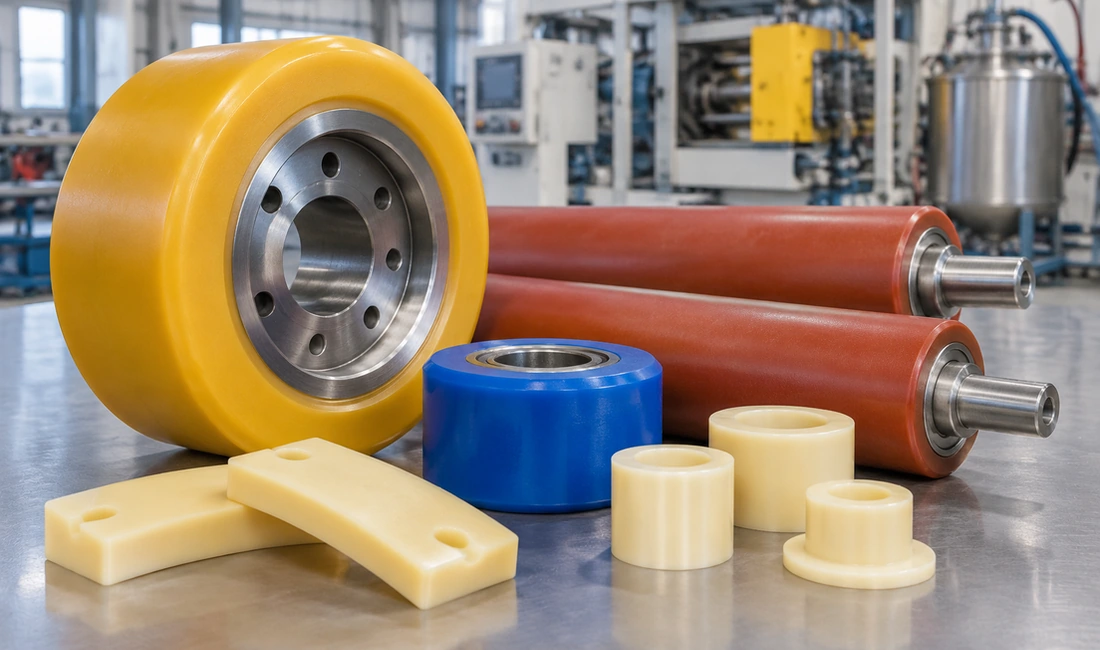
That liquid stage is the main advantage. The material flows around metal cores, into deep sections, and through thin gaps at low pressure. Cast PU covers a wide hardness range, from about 30 Shore A to 75 Shore D. Tensile strength usually falls between 30 and 55 MPa. One process therefore serves soft printing rollers and hard forklift treads.
Cast PU wins on load and abrasion, while rubber wins on heat and grip. A cast PU tread at 92 Shore A supports far more weight than a rubber tread of the same size. Catalogue load ratings are commonly two to three times higher at the same wheel diameter.
Rubber keeps three clear advantages. Natural rubber handles continuous service above 100 °C more comfortably, while cast PU normally runs up to about 80 °C. Rubber also grips wet floors better and costs less on large, simple parts. Wet heat is the other limit, because polyester based PU can break down by hydrolysis in steam, so polyether grades suit wet duty better.
Casting suits low to medium volumes, large parts, thick sections, and soft grades. Casting moulds can be machined from aluminium or mild steel. Injection moulds need hardened steel and only pay back over runs of tens of thousands of parts.
Three cases favour casting clearly. First, part diameters above roughly 300 mm, such as conveyor rollers and mill liners. Second, wall sections thicker than 15 mm, which sink and warp in injection moulding. Third, hardness below 80 Shore A, which sits outside the range of most injection grade TPU. A plant running 200 rollers a month across six sizes falls into all three cases at once.
The process runs in three blocks. The first block prepares and primes the metal core while conditioning the mould. The second block degasses and meters the components, then pours. The third block covers demoulding, post-cure, and machining to final size.
Bond strength is decided before any PU is poured. The steel core is grit blasted to a near-white finish, Sa 2.5, with a surface profile of 40 to 75 µm. Operators then degrease the blasted surface with solvent and apply a two part adhesive primer, usually within four hours. A fresh blast starts to oxidise quickly, so that window matters.
The primed core is then baked at 100 to 120 °C to drive off solvent and activate the film. Moulds are preheated to 80 to 110 °C, depending on the material system. A cold mould chills the flow front and traps flow lines. Parts that must release, such as screen panels, take a semi-permanent release agent instead of primer.
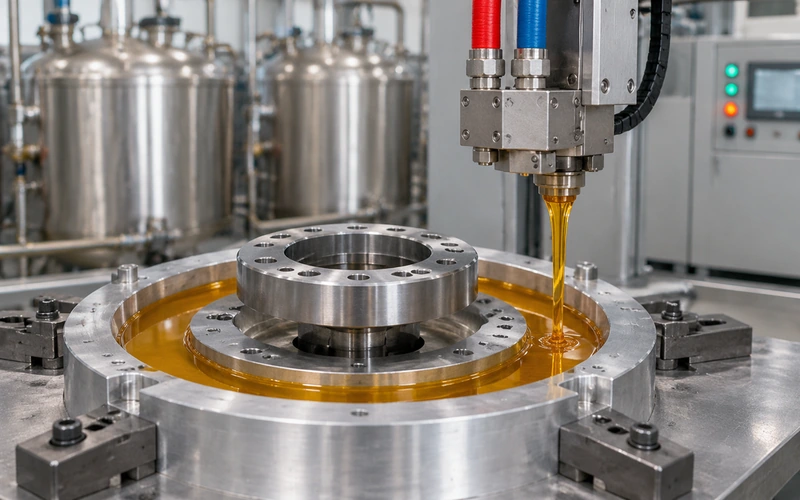
Vacuum degassing removes dissolved air before the pour. The prepolymer is heated to 70 to 100 °C and held under vacuum at 1 to 10 mbar for 20 to 30 minutes. Solid curatives melt in a separate heated tank. MOCA, for example, melts near 110 °C and is dosed at 115 to 120 °C.
The machine then doses both streams at the recipe ratio and blends them in a dynamic mixing head. Pot life is the working window that runs from mixing until the blend gels, often two to six minutes. The pour enters at the lowest point of the cavity in one steady stream, so the mould fills from the bottom up. A thin, splashing stream folds air into the part.
The part gels in the mould, then finishes curing in an oven. Demoulding usually happens 20 to 60 minutes after the pour, once the part holds its shape. Post-cure then runs at 100 to 110 °C for about 16 hours. Skipping post-cure leaves the network incomplete, which cuts tear strength and wear life sharply.
Machining comes last, because cast parts shrink by roughly 1 to 2 percent. Most wheels and rollers are ground to size. Grinding holds diameter tolerances near ±0.05 mm. Rollers that run above 300 rpm also need dynamic balancing, commonly to ISO 1940 grade G6.3.
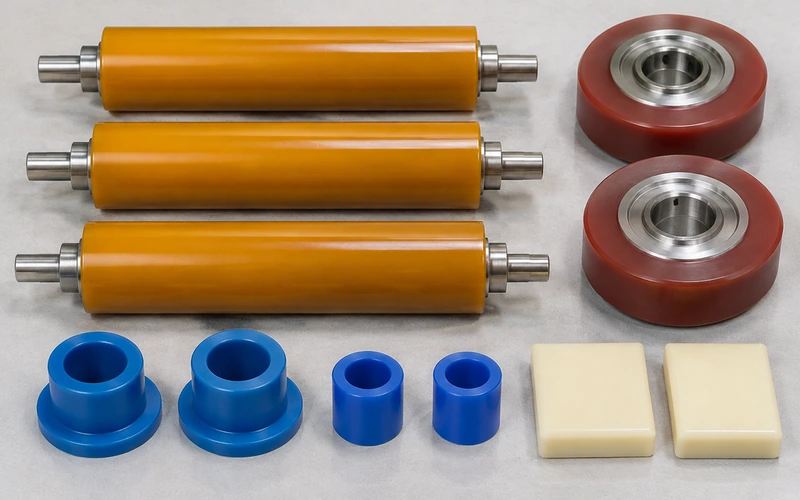
Part geometry changes the setup more than the chemistry does. Wheels need short cycles and reliable hub bonding. Rollers need long, even fills and balancing. Industrial wear parts need thick sections with longer pour and cure windows.
Forklift, AGV, and trolley treads sit between 90 and 95 Shore A, while heavy press-on bands go harder, often 60 to 75 Shore D. Moulds are split steel tools, and most shops run four to twelve cavities to keep cycles down.
The hub bond carries the whole load. A tread sees shear at the bond line every time the truck starts, stops, or turns. Tread separation is therefore the failure mode to design against.
Rollers demand even filling over long distances. Cast rollers range from 100 mm to more than 6 m long, with coating walls of 5 to 25 mm. Hardness spans 30 Shore A for soft printing rollers up to 75 Shore D for drive rollers.
Most shops cast rollers vertically. The PU rises through the gap between the core and the mould tube, which pushes air ahead of it. A long roller also needs more material than a single manual batch can supply, so metering output must match the fill volume.
Wear parts trade cycle time for section thickness. Mining screen panels, wear pads, impellers, and bushings often run 20 to 50 mm thick at 85 to 95 Shore A. Thick sections hold reaction heat, so the exotherm can push the core temperature well above the mould setting.
A slightly cooler pour and a longer gel time let that heat spread out. Many panels also carry steel wire or frame inserts, which need the same priming as a wheel hub.
| Part type | Typical hardness | Mould type | Section thickness | Critical control point |
| Wheels and treads | 90–95 Shore A | Split steel, multi-cavity | 10–30 mm | Hub bond preparation |
| Rollers | 30 Shore A – 75 Shore D | Vertical tube mould | 5–25 mm | Even fill and balancing |
| Screen panels and wear parts | 85–95 Shore A | Open or framed tool | 20–50 mm | Exotherm and insert priming |
Three machine variables decide the result: metering ratio accuracy, mixing energy at the head, and temperature control across tank, hose, and mould. A deviation in any of the three shows up as bubbles, soft spots, or bond failure.
Ratio accuracy sets hardness. Most systems need the curative dosed within ±1 percent of theory. At 95 percent of theory, the network is short of chain extender and the part reads several Shore points soft. Servo driven metering pumps with closed loop feedback hold that window shift after shift.
Mixing energy sets homogeneity. A dynamic mixing head with an adjustable speed rotor blends both streams in a few seconds. Vacuum degassing sets porosity, and it works only if the tank holds a stable low pressure. These three controls are why open batch dosing gives way to a dedicated PU elastomer casting machine once output moves to repeatable production volumes.
Each material system has its own temperature window, and the machine must hold it end to end. A TDI and MOCA system runs the prepolymer at 70 to 80 °C, the curative near 118 °C, and the mould at 100 to 110 °C. An MDI and butanediol system runs cooler, with prepolymer at 60 to 80 °C and moulds at 80 to 100 °C.
Pot life falls as temperature rises. A 10 °C increase can cut working time by half. Hoses and the mixing head therefore need heat tracing. A cold hose section changes viscosity, shifts the true ratio, and leaves a soft streak in the part.
Each defect points to one variable, which narrows the search. Bubbles and pinholes point to degassing or pour technique, so the first checks are vacuum level, hold time, and stream quality. Soft spots and low hardness point to ratio drift. The checks there are pump calibration and curative tank temperature, since crystallised curative doses short.
Bond failure points to core preparation rather than the machine. The relevant records are blast profile, the delay before priming, and the primer bake. Flash and short shots point to mould temperature or shot size. Logging these checks against every batch turns troubleshooting into a five minute routine.
Specification starts with four inputs: material system, part size, mould type, and target output. These four decide tank sizing, temperature capability, metering range, and automation level. A supplier needs all four before recommending a configuration.
A useful specification records five items. It names the material system by chemistry, such as TDI with MOCA. It gives the largest and smallest shot weight in kilograms. It states mould type and cavity count. It ends with the output target and the hardness range in service.
Shot weight matters most for pump sizing. A 2 kg caster wheel and a 60 kg mill liner need very different output ranges. Both ends belong in the specification, since one machine can often cover the span with the right pump and head.
A high-temperature casting system is a machine that holds every wetted part above the melting point of a solid curative. MOCA and HQEE both melt above 100 °C. They crystallise inside any tank, line, or pump that drops below that point, which blocks flow and starves the ratio.
A high temperature elastomer casting machine is built for these systems, with heated tanks and controlled line temperatures through to the mixing head. Recipes based on liquid curatives, such as butanediol blends, run on a standard heated unit instead.
Buyers should confirm that the machine is tested with their own material before it ships. A useful run-off shows ratio accuracy across the full output range, not at a single setting. The commissioning scope should also be written down, including operator training, recipe setup, and the first production batches.
The next question is integration with the rest of the shop. Casting sits between core preparation, oven curing, and grinding. Suppliers that build a wider polyurethane and polyurea processing line can align those steps instead of dropping in a standalone unit.
No. Equipment suppliers build, test, and commission the machine. Prepolymer and curative come from chemical suppliers. That split keeps the formulation in-house, which protects product know-how and allows a change of material source without a change of machine.
Yes, with the right flushing setup. Automatic solvent or air flush clears the mixing head after every shot. A change of chemistry still needs a full line purge and a temperature change, so most plants group similar systems and schedule changeovers together.
On-site commissioning usually takes a few days to about two weeks. It covers installation, calibration, operator training, and trial production, after technical review and factory testing. Line complexity and site readiness decide where a project lands in that range.
Cast PU holds its place on wheels, rollers, and wear parts because one liquid process covers 30 Shore A to 75 Shore D. Five points carry most of the result. Prime the metal core first, degas under vacuum, hold the ratio within ±1 percent, keep every wetted part inside its temperature window, and never skip the post-cure. Part geometry then sets mould type and cycle time, while the material system sets temperature capability.
Turning those requirements into a machine specification works best against real parts. Drawings, samples, or target figures make the review concrete, including part size, hardness target, mould plan, and daily output. Share those details and the BOBO Machine engineering team can recommend a suitable casting configuration.