Spray Foam Insulation Equipment: Open-Cell vs Closed-Cell Production Requirements
Jump to section
Open-cell and closed-cell spray foam come from the same family of equipment. The chemistry differs, but both are sprayed by plural-component machines. What changes is how the machine is configured and how hard it has to work. This article compares the production requirements behind each foam type, so buyers can match equipment to the foam they plan to spray.
Spray foam insulation equipment is a multi-component system that heats, pressurises, and proportions two liquid chemicals before mixing them at the spray gun. The same class of machine can produce either foam type. The result is decided by the chemical system, the machine settings, and the operator’s technique.
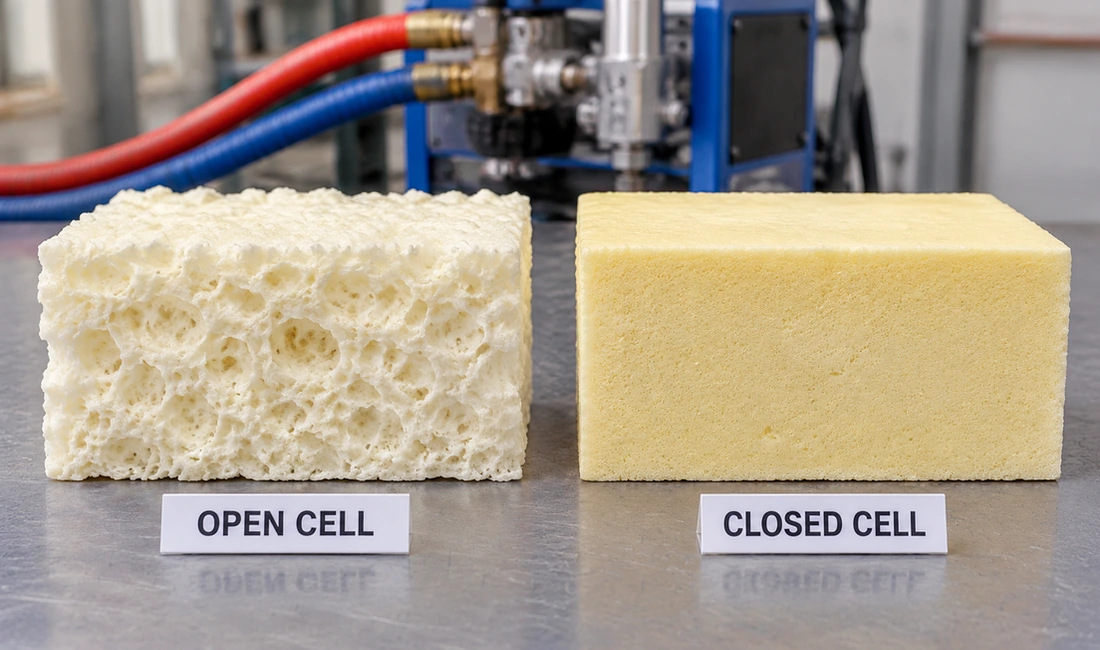
Both foams start from the same two streams. The A side is polymeric MDI, an isocyanate. The B side is a blend of polyol resins, surfactants, catalysts, and fire retardants. The blowing agent in the B side is what separates the two products. Open-cell systems use water. Closed-cell systems use a gas blowing agent. That single difference changes almost every production value that follows.
| Property | Open-Cell Foam | Closed-Cell Foam |
| Density | About 0.5 lb/ft³ (8 kg/m³) | About 2.0 lb/ft³ (32 kg/m³) |
| R-value per inch | R-3.5 to R-3.7 | R-6.0 to R-6.5 |
| Blowing agent | Water | Gas (HFC or HFO) |
| Expansion ratio | Up to about 100 times | About 30 to 60 times |
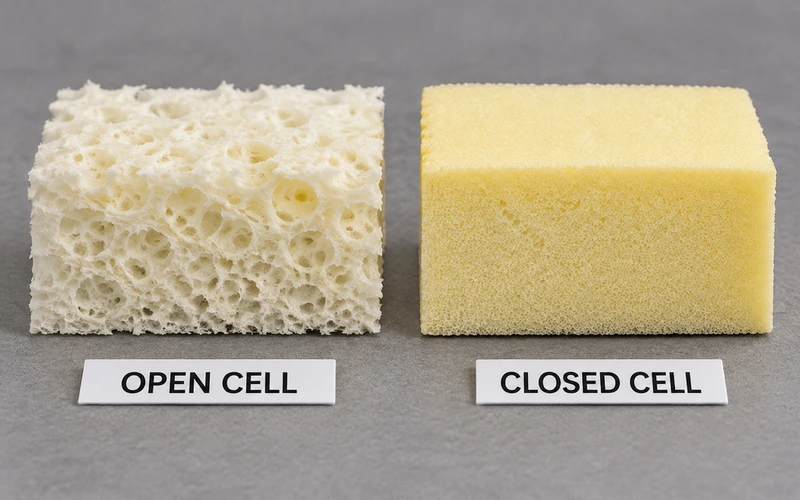
| Cured structure | Soft, interconnected cells | Rigid, sealed cells |
| Pass thickness | Thicker lifts accepted | About 2 inches per pass |
Those values are delivered by the same three-part equipment chain.
Three components decide foam quality, and each one controls a different variable.
A proportioner is the pump unit that heats both chemical streams, raises them to spray pressure, and delivers them at a fixed ratio. Most systems run a 1:1 ratio by volume. If that ratio drifts, the reaction is incomplete, and the foam never reaches its rated density or R-value.
The heated hose carries both streams from the machine to the gun. Runs of 200 to 300 feet (60 to 90 metres) are common on building sites. Over that distance, the chemicals lose heat, so the hose holds them at working temperature until the moment they meet.
The spray gun mixes the two streams by impingement. The streams collide inside a small chamber at high speed, combine in a fraction of a second, and leave the tip as a single reacting spray. Gun condition therefore has a direct effect on cell structure. Both foam types can run through the same gun body, and polyurethane spray foam machines are normally supplied with matched hose and gun packages for this reason.
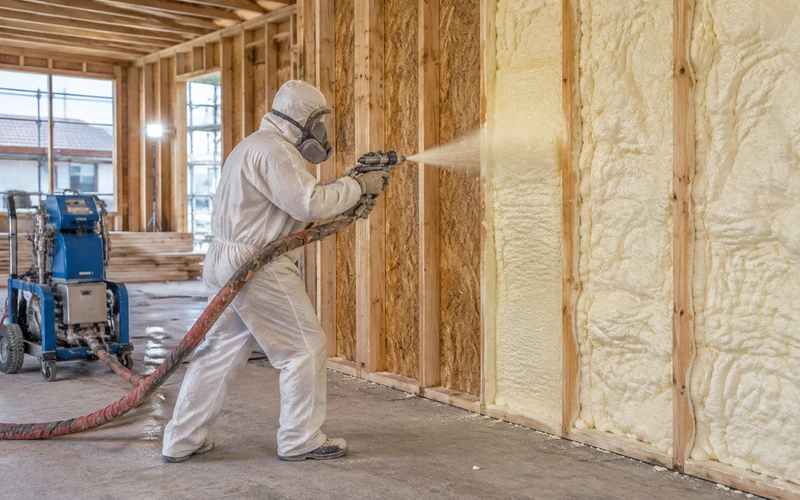
Closed-cell production places heavier demands on the machine. It needs higher pressure, tighter temperature control, and thinner passes. Open-cell production needs higher output and a larger mix chamber, because the material expands far more after it leaves the gun. The differences surface in three places.
Closed-cell systems run at higher pressure and temperature settings than open-cell systems. The closed-cell B side is more viscous, so it needs more pressure to atomise properly and mix cleanly at the gun. Its gas blowing agent also reacts within a narrower temperature window. If the material runs cool, the gas expands weakly, the foam cures denser than specified, and the wall receives less R-value than the specification requires.
This is why heating capacity, not pressure alone, separates machines built for closed-cell production. A separate aluminium heater with a high-output heating element holds temperature during long spraying runs, and digital temperature control with overload protection keeps the setting stable rather than drifting under load.
Open-cell production is more forgiving on temperature. Water is a stable blowing agent and tolerates wider swings. Output matters more instead. Because open-cell foam fills a cavity in far fewer kilograms of material, crews cover large surfaces quickly, and the machine must keep up without pressure drop.
Exact settings depend on the machine model, the hose length, and the chemical supplier’s data sheet. That document, not a general rule, defines the correct target.
Expansion ratio is the multiple by which liquid chemical grows in volume as it cures, and it reshapes the whole production plan. Open-cell foam expands up to about 100 times. Closed-cell foam expands about 30 to 60 times. One drum of open-cell material therefore covers far more surface area than one drum of closed-cell material.
That ratio drives mix chamber selection. Open-cell work usually calls for a larger chamber and a wider spray pattern, so the operator can lay down a thin liquid film that grows to fill a deep cavity. Closed-cell work uses a tighter pattern for controlled build-up.
Pass thickness follows the same logic. Closed-cell foam is normally limited to about 2 inches per pass. The reaction releases heat, and a thick lift traps that heat inside the foam mass. The core over-reacts while the surface cures normally, which leaves internal stress, cracking, and loss of adhesion. Open-cell foam releases less heat and can be applied in thicker lifts, often filling a stud cavity in a single pass.
Most foam defects are equipment problems rather than chemical problems. Three causes account for the majority of them.
Off-ratio mixing is the most common. It appears when drum temperatures are uneven, when the two hose lines run at different temperatures, or when a pump seal wears. The foam may look acceptable but stays soft, smells strongly, or fails a density check. Stainless steel proportioning pumps reduce seal abrasion and extend the interval between these faults, and a test shot before each shift catches the rest.
Cold substrate causes the second group. Foam sprayed onto a cold surface bonds poorly and pulls away as it cures. Drum heaters and hose temperature control solve the machine side, but the surface itself must also be within the supplier’s stated range.
Excessive pass thickness causes the third, through the trapped exotherm described above. The fault comes from operator technique, though a correctly set spray pattern makes controlled lifts far easier to achieve.
Yes. One plural-component machine can run both foam types, provided it is flushed, recalibrated, and test-sprayed between systems. The limit is not technical capability but changeover time, and the changeover sequence decides how costly that flexibility becomes.
A clean changeover follows a fixed order. The crew first flushes both sides to clear residual material from the pumps, hose, and gun. Machines fitted with an on-board solvent tank make this step routine, since DOP solvent can be circulated through the wetted path without dismantling the line. Leftover closed-cell resin in an open-cell line will contaminate the first output of the next batch.
The machine is then reset to the incoming system’s pressure and temperature targets, and the ratio is verified by drawing samples from both sides. Finally, the crew fires a test shot onto a scrap board and checks the cured sample for density and cell structure. Production resumes only after that sample passes.
A dedicated machine pays off when changeovers become frequent rather than occasional. A contractor who sprays closed-cell foam in basements one week and open-cell foam in interior walls the next loses little to a monthly changeover. A workshop that switches daily loses hours every day.
Cold room panel work shows this clearly. Panel production runs closed-cell foam almost exclusively, at steady daily volume, to a fixed density target. A machine held on one system keeps its calibration and produces consistent panels shift after shift. Where panels are filled in a mould rather than sprayed onto a surface, a polyurethane foam pouring line suits the process better than a spray unit.
Three inputs decide the configuration: the foam system to be sprayed, the daily output target, and the working conditions. Closed-cell work in cold conditions sets the highest specification, so if it appears anywhere in the workload, it defines the machine. Two decisions follow: system type and machine class.
High-pressure equipment is the standard for commercial production. It heats and pressurises both streams mechanically, then mixes them at the gun by impingement. That method holds mixing quality across long hose runs and under continuous load, which is what closed-cell foam requires to reach its density target. Low-pressure systems depend on pre-pressurised supply and lower output, so they serve intermittent work rather than daily production volume.
Drive type is the next decision. Pneumatic proportioners suit site work on walls, roofs, and pipe insulation, where power supply varies between locations and the machine moves often. Their performance holds up better than electric alternatives under the dust, damp, and voltage swings typical of active job sites.
The proportioner is only part of the system. A working installation also needs transfer pumps to move material from the drums, an air dryer and filter to keep moisture out of the lines, a compressor or generator sized to the machine’s load, and drum heaters for cold-weather work. Buyers who budget for the proportioner alone are usually surprised by these items later.
Output target sets the machine size, and foam type sets the heating and pressure capacity. The two must be specified together.
A crew spraying open-cell foam in residential interiors needs high throughput but moderate heating capacity, because the material is forgiving and the runs are short. A contractor spraying closed-cell foam on roofs and exterior walls needs stronger heating, because the material is viscous and the hose runs are long. A panel or cold storage producer needs stable, repeatable output above all, since density is checked against a specification rather than judged by eye.
Buyers can work backwards from the job. A daily target in square metres, converted to board feet at the specified thickness, gives the material weight per shift. That figure sets the required output rate, and the output rate sets the machine class. BOBO applies the same method across its foam insulation equipment for building, panel, and cold room projects.
Cold conditions call for higher drum and hose temperatures to hold the chemicals within their reaction window. Machines with dedicated aluminium heaters and digital temperature control handle winter work more reliably. The substrate is the larger risk: a surface below the supplier’s minimum temperature will cause poor adhesion no matter how the machine is set.
Closed-cell foam consumes more material by weight for the same wall area. It expands roughly a third to half as much as open-cell foam, so a given cavity takes far more kilograms to fill. Closed-cell foam reaches the same R-value in about half the thickness, but its higher density still makes it the more material-intensive option.
Foam type sets the pressure and heating requirement, daily output sets the machine size, and the most demanding job in the workload defines the specification for both. Open-cell and closed-cell foam can share one machine, but only where changeovers stay occasional.
BOBO reviews each project from that starting point. A drawing, sample, or target output figure sent through the contact page lets the engineering team confirm spray output, material system, and temperature requirements before proposing equipment and planning commissioning, operator training, and after-sales support alongside it.