Paper Cup Machine Speed and Capacity: How to Match Output to Demand
Jump to section
Most buyers choose a paper cup machine by its rated speed, but customers judge them on delivered cups. The two figures are never the same. A nameplate speed assumes ideal conditions, while real shifts include changeovers, paper reloads, short stops, and rejects. This article explains how to work back from order volume to the machine speed a plant actually needs.
Paper cup machine speed is the rated forming rate, given in cups per minute under ideal running conditions. Capacity is the output the machine holds across a full shift, after downtime, changeovers, and rejects are deducted.
The two figures answer different questions. Speed shows what a machine can do at its best. Capacity shows what a plant can safely promise a customer.
Rated speed is the peak forming rate a machine reaches when everything runs cleanly. It assumes correct paper, a stable air supply, a warmed-up sealing system, and no interruptions. Suppliers measure it on a single cup size, usually a mid-range one, because small cups run faster than large ones.
Sustained capacity is the output the same machine delivers over eight hours of normal work. The gap between the two figures is usually wide. A machine that holds 90 cups per minute all shift is worth more than one that touches 110 briefly, then jams. Frequent stops also cost material, because the first cups after a restart are usually scrap.
Buyers should therefore ask two questions about any quoted speed: which cup size it was measured on, and what output it holds across a full shift.
Paper cup machines fall into three broad speed classes. Exact boundaries vary between suppliers, so the class name matters less than the number behind it.
| Speed Class | Rated Speed | Theoretical Output per 8-Hour Shift | Typical Use |
| Low speed | Up to about 60 pcs/min | Up to about 28,800 cups | Start-ups, single-site supply, trial production |
| Medium speed | About 60 to 100 pcs/min | About 28,800 to 48,000 cups | Contract supply, distributors, steady repeat orders |
| High speed | Above about 100 pcs/min | Above 48,000 cups | Large converters running full shifts year round |
The shift figures above are theoretical. They multiply rated speed by 480 minutes and assume no stops, so they serve only as a ceiling. Many buyers of paper cup machines settle in the low and medium classes, since that range covers the volumes most foodservice converters run.
Required speed is found by dividing the daily cup target by the effective running minutes in a shift, then dividing again by the yield rate. Monthly order volume, working days, and shift length set that daily target. The arithmetic is simple, and skipping it is a common buying mistake.
The calculation has two halves: what the plant must produce, and what the machine loses along the way.
Three deductions separate rated speed from delivered cups, and each one is measurable.
Uptime is the share of scheduled time the machine actually runs. Paper reloads, short jams, sensor faults, and cleaning all subtract from it. A well-run automatic line commonly achieves 80 to 90 percent uptime once operators are trained. New installations start lower.
Changeover time is the period lost when switching cup size or artwork. It covers mould changes, tooling adjustment, and the trial cups run before quality is stable. A plant that changes size once per shift loses far more than one running a single size all week, even with identical machines.
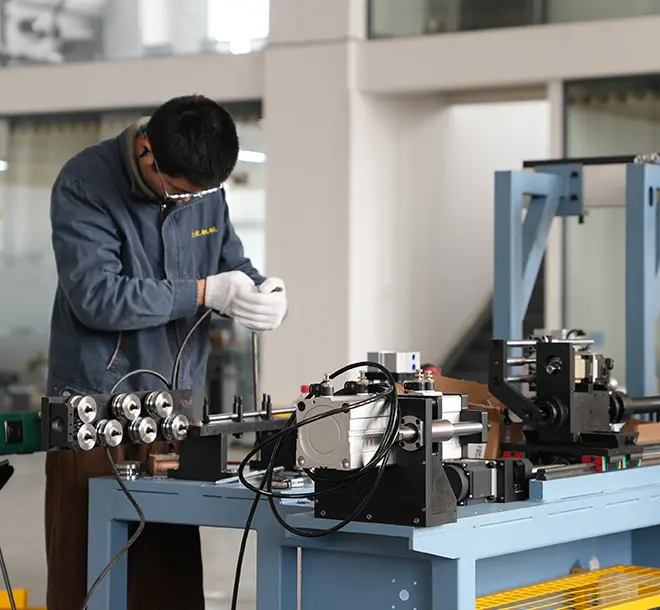
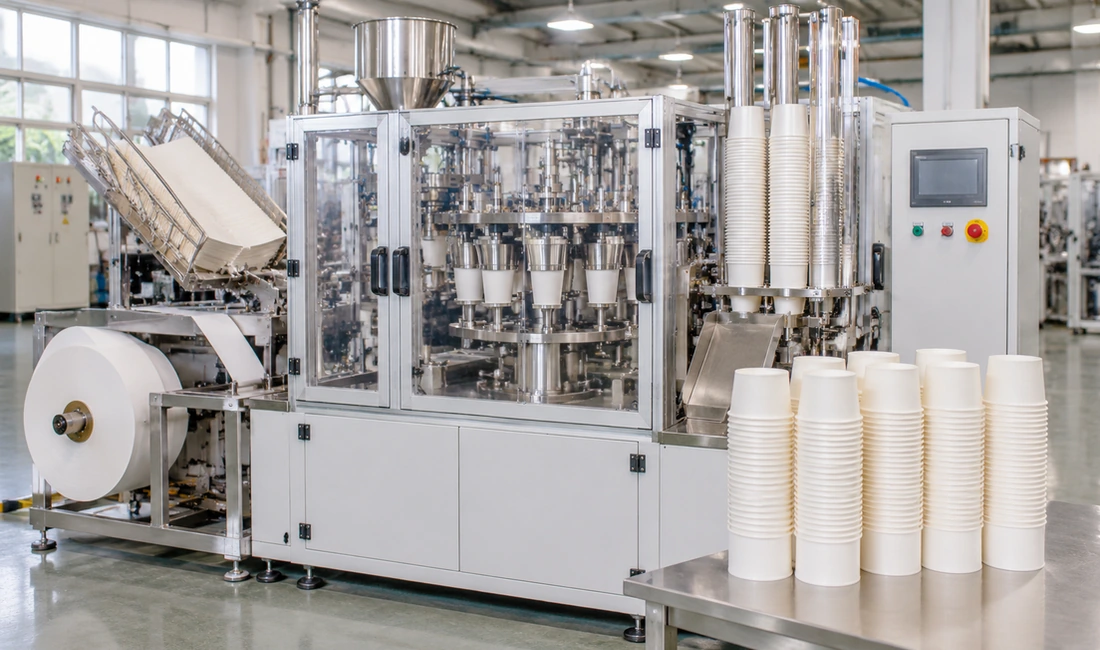
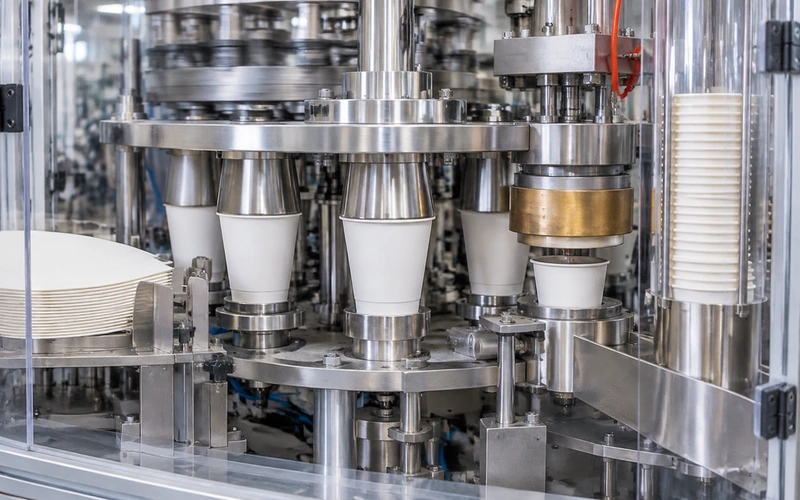
Yield rate is the share of formed cups that pass inspection. Rejects come from misfed paper fans, weak side seams, and bottom folding faults. A dual-feed system with an anti-withdrawal device positions each paper fan before forming, which removes most misalignment scrap. Photoelectric detection and fault alarms protect yield by stopping the machine before scrap accumulates. Even so, no line runs at 100 percent.
A worked example shows how large the gap becomes. Consider a machine rated at 80 cups per minute, running one eight-hour shift.
The theoretical ceiling is 80 × 480 minutes, or 38,400 cups. At 80 percent uptime, effective running time drops to 384 minutes, which gives 30,720 cups. Applying a 97 percent yield rate leaves roughly 29,800 good cups per shift. The delivered figure is about 22 percent below the nameplate.
The same maths also runs backwards, and that is how buyers should use it. Suppose a converter holds orders for 800,000 cups per month and works 26 days. That is about 30,800 cups per day. Dividing by 384 effective minutes gives 80 cups per minute, and adjusting for yield pushes the requirement to about 83. A machine rated at 80 will fall short. A machine rated at 90 to 100 covers the volume with room for growth.
The practical rule is to add roughly 20 to 25 percent to the rated speed that a simple hourly calculation suggests. That margin absorbs normal losses and prevents a plant from buying capacity it cannot actually deliver.
Larger cups, heavier paper, and double-sided coatings all reduce the achievable forming rate. Downstream stations set a second ceiling, because total line output equals the slowest station rather than the cup machine’s rated speed.
Both limits are easy to overlook at the quotation stage, and both are expensive to fix afterwards.
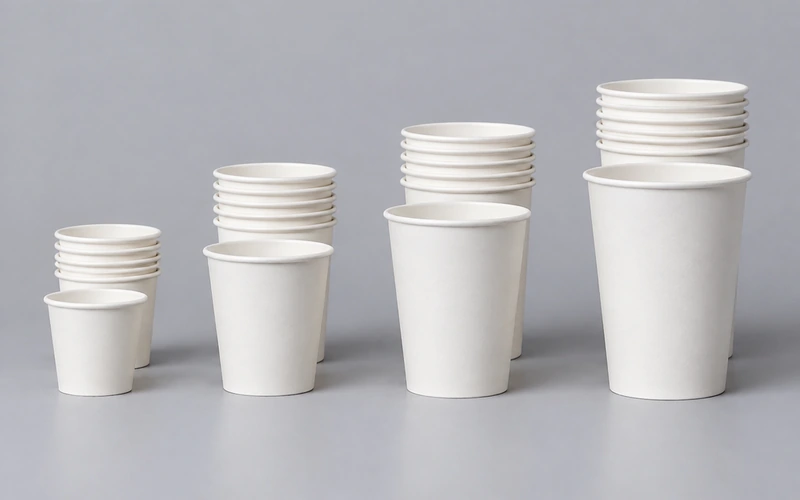
Cup size and paper weight change both speed and material consumption. A machine quoted at 70 to 90 cups per minute on an 8 oz cup will run slower on a 16 oz cup. The paper fan is larger, the forming stroke is longer, and the bottom seal needs more heating time.
Paper weight moves in step with cup size. Cup stock generally runs from 150 to 350 GSM, with heavier grades used for larger cups and double-wall formats. Heavier board resists folding, so knurling and rim curling need slightly more dwell time.
Material yield shifts sharply as well. A tonne of 160 GSM stock yields roughly 400,000 4 oz cups, while a tonne of 280 GSM stock yields only about 150,000 12 oz cups. A plant moving toward larger sizes therefore needs both more machine speed and more paper for the same cup count.
Coating type affects sealing rather than speed. Single-sided PE coated paper suits hot drink cups, while double-sided coating suits cold drinks. Ultrasonic side-seam welding handles both without glue or drying time.
Line capacity is set by the slowest station, not the fastest. A cup line runs through feeding, printing, forming, sealing, counting, and stacking. If any one of those stages runs below the cup machine’s rate, the extra speed is wasted and work in progress piles up on the floor.
Lids are the clearest example. A converter supplying full cup and lid sets needs lid output to track cup output across the same shift pattern. Where the paper lid making machine is rated below the cup machine, the plant either buys lids in or runs the lid line on extra shifts. Both options cost money that a faster cup machine cannot recover, so lid capacity should be confirmed at the quotation stage.
Packing is the other common bottleneck. Automatic counting and stacking keeps pace with a medium-speed machine, but hand packing rarely does. A plant that adds a faster cup machine but keeps the same packing end usually spends the new capacity on overtime instead of sales. The fix is to specify the line as a whole, matching each station to the same target output before ordering.
Machines are matched to demand by daily volume and by how steady that volume is. Medium-speed machines suit contract supply with repeat orders. High-speed machines pay off only when the order book keeps them loaded across full shifts.
Two decisions follow: which speed class to specify, and whether to concentrate capacity in one machine or spread it across two.
Daily volume sets the speed class, and order stability confirms it. A plant supplying one region or launching a private-label line rarely needs more than 30,000 cups a day, which a low or medium-speed machine covers in a single shift. A distributor holding standing orders across several accounts is usually in the 30,000 to 50,000 range, which points to the medium class.
Order stability decides the rest. High-speed machines carry their advantage only at high utilisation. A machine rated above 100 cups per minute that runs three days a week costs more per cup than a medium-speed machine running five days, because the capital is spread across fewer cups. Seasonal producers face this directly, since cold drink cup demand peaks in summer and falls in winter.
Growth deserves headroom, but not too much. Specifying one class above current demand is sensible; two invites idle capacity and a longer payback.
Two medium-speed machines beat one high-speed machine whenever product mix or reliability matters more than peak output. The comparison turns on three factors.
Changeover flexibility favours two machines. One can hold a long run of 8 oz cups while the other switches to 12 oz, so neither line stops for tooling. A single machine must stop for every size change.
Risk favours two machines as well. A fault on a single high-speed line halts all output. With two lines, a fault cuts capacity rather than ending it, which protects delivery dates on contract orders.
Cost and floor space favour one machine. A single line needs one operator team, one set of spare parts, and less floor area than two. A plant with a narrow product range and stable volume is usually better off concentrating capacity in one line. Those running mixed sizes across paper product forming and converting operations generally gain more from two independent lines.
Most plants need several weeks to reach rated speed. Commissioning and operator training usually take a few days, and output keeps climbing after that as operators learn paper handling, tooling changes, and fault clearing. Buyers should plan the first month at reduced output and confirm that commissioning and training are included before shipment.
A fully automatic machine typically needs one operator, who can often supervise two machines once trained. The workload sits in paper loading, quality checks, and clearing faults rather than forming. Packing usually needs additional labour unless automatic counting and stacking is fitted, so labour planning should cover the whole line rather than the cup machine alone.
Order volume decides the machine speed a plant needs, and the slowest station decides what the line actually delivers. Both figures must be calculated before a model is chosen, since a nameplate speed alone cannot tell a buyer whether the plant will meet its orders.
BOBO reviews each project from that starting point. Sending cup size, paper GSM, coating type, and a target output through the contact page lets the engineering team confirm a suitable configuration and match upstream and downstream stations to the same rate. The team also plans commissioning, operator training, and after-sales support alongside the machine.