Paper Plate Production: Single Wall vs Compartment Plate Equipment
Jump to section
Single-wall and compartment paper plates use similar forming principles, but they do not place the same demands on the mold and machine. Plate geometry affects mold design, forming force, heat control, paper behavior, cycle stability, and product handling.
These differences matter when a manufacturer plans a new production line or adds new plate sizes and formats. This guide compares both plate types from an equipment perspective, explains when one machine may handle both formats, and outlines the production and cost factors that should be checked before equipment selection.
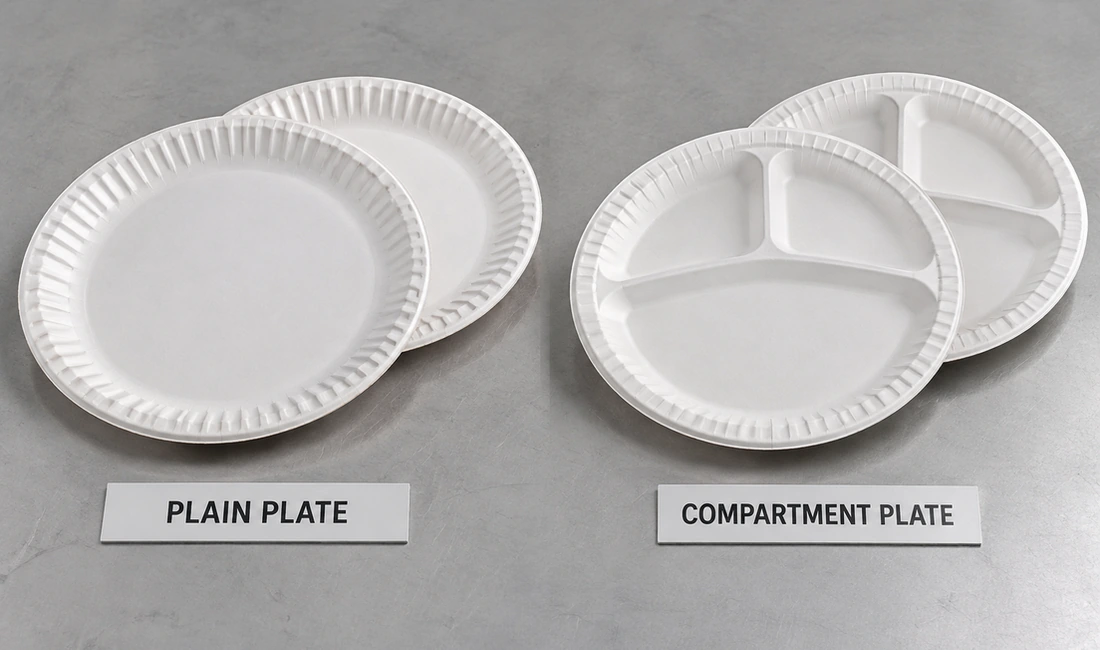
The main difference is the geometry that the equipment must form. A single wall plate has one continuous food-contact area, while a compartment plate contains two or more separate food sections. The additional ribs and cavities change mold geometry and can make forming control more demanding.
A single wall paper plate is a disposable paper plate that has one continuous food-contact area without internal dividers. In this guide, “single wall” refers to the standard, undivided plate format, which may also be described as a plain or standard paper plate.
The mold forms the base, sidewall, rim, and any surface pattern as one connected profile. Common formats include round dinner plates, square snack plates, and shallow serving plates. Their relatively simple geometry generally reduces the number of features that must be formed during each cycle.
A compartment paper plate is a disposable paper plate that contains two or more formed sections for separating different foods. Common formats include two-compartment lunch plates, three-compartment meal plates, and other divided serving plates.
Each divider adds another feature that the mold must reproduce. The mold forms the plate body, rim, cavities, and raised ribs during the same cycle, so divider height and cavity depth must remain consistent across the finished plate.
Plate geometry changes equipment requirements because the mold must reproduce every curve, wall, rim, cavity, and divider under controlled heat and pressure. Deeper cavities or more detailed dividers can change how the paper moves and forms inside the tooling.
The relationship is direct: plate geometry defines the mold requirements, while the mold determines the forming conditions that the machine must provide. Equipment selection should therefore begin with the finished plate specification rather than production speed alone.
Single wall and compartment plate equipment mainly differ in mold complexity, forming control, material response, output stability, and product handling. Compartment plates contain more shaped zones, so pressure, temperature, sheet positioning, and release must remain consistent across the complete plate.
| Comparison Factor | Single Wall Plate Equipment | Compartment Plate Equipment |
| Plate geometry | One continuous food-contact area | Two or more divided sections |
| Mold structure | Simpler cavity profile | More complex ribs and cavities |
| Forming control | Fewer shaped zones | Multiple zones must form evenly |
| Material response | Strongly affected by size and depth | Also affected by divider geometry |
| Output stability | Generally easier to stabilize | More sensitive to forming consistency |
| Changeover | Depends on mold and machine limits | Requires closer mold-machine matching |
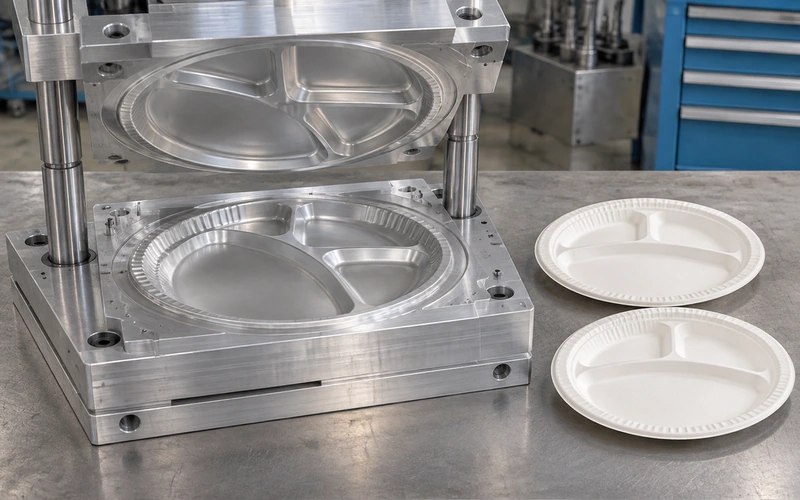
Paper plate mold structure controls the finished shape and directly affects equipment requirements. A standard plate mold mainly forms the base, sidewall, and rim, while a compartment mold also creates raised dividers and multiple food sections.
A plate drawing should define the diameter, depth, rim profile, compartment layout, and any embossed features. These specifications allow the equipment supplier to evaluate tooling requirements and determine whether the mold can operate within the machine platform.
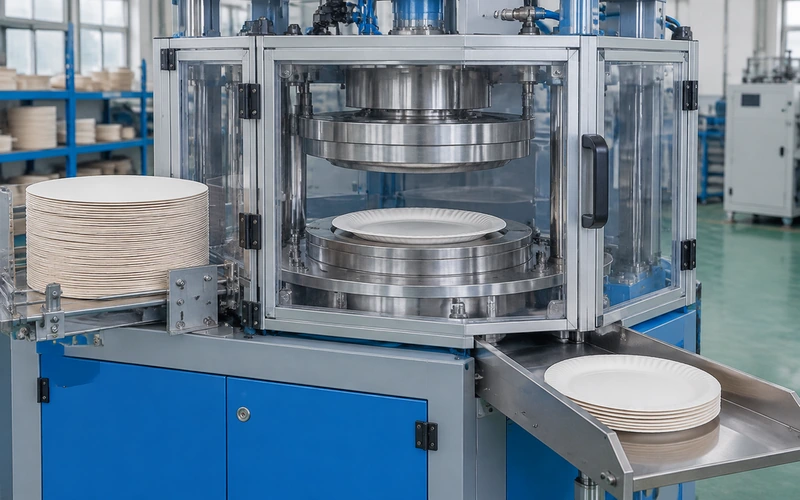
Heating and forming pressure help the paper take the required shape without tearing, surface damage, or incomplete definition. Stable process settings are important for both plate formats, but compartment designs may require closer control because several features must form evenly during one cycle.
Insufficient forming force can produce shallow ribs or poorly defined edges, while unsuitable heat settings can affect surface quality or forming consistency. The correct process window depends on the paper, coating, mold geometry, and plate depth.
Paper compatibility depends mainly on GSM, stiffness, coating, and forming behavior. A heavier board may provide greater rigidity but can also require different forming conditions, while coated materials must maintain their surface integrity during heating and pressing.
For reference, BOBO’s hydraulic paper plate making machine lists a material range of 100–800 g/m² and supports base paper, whiteboard paper, white cardboard, and aluminum-foil paper. The final material specification still needs to be matched to the finished plate and mold.
Production speed should be evaluated by acceptable finished output rather than rated cycles alone. Feeding, forming, release, stacking, changeover time, and rejected plates all influence the practical production rate.
BOBO’s dual-station hydraulic paper plate machine is rated at 80–140 pieces per minute within its stated operating range. Actual usable output still depends on the mold, paper specification, plate geometry, and stable forming conditions.
This distinction becomes particularly important for compartment plates. A fast press cycle provides little production benefit if divider definition or plate release becomes inconsistent.
Ejection and stacking must remove and collect each plate without deforming the rim, base, or compartment dividers. Standard plates often have relatively simple nesting profiles, while deeper or divided formats may require closer attention to release and stacking behavior.
Product handling should therefore be evaluated together with forming quality. A plate that forms correctly but deforms during ejection or stacks poorly can still reduce usable production efficiency.
One paper plate machine can produce both formats when the machine specifications, mold, paper material, plate geometry, and output requirement are compatible. A mold change may be sufficient for some projects, while other products require different tooling, process settings, handling, or machine configuration.
A mold change may be sufficient when the new plate remains within the machine’s working limits. Important limits include plate size, mold dimensions, stroke, forming force, heating capacity, material range, and discharge space.
BOBO’s hydraulic paper plate machine, for example, lists a plate size range of 4–15 inches and a cylinder stroke of 150 mm. These values illustrate why the actual plate dimensions and mold design need to be checked before new tooling is approved.
Several related SKUs may therefore be produced on one machine platform when their requirements are compatible. Diameter alone, however, does not confirm compatibility.
The machine configuration may need to change when a new plate requires deeper forming, different tooling dimensions, greater forming demand, another handling method, or a production rate that the existing setup cannot maintain.
A mold may produce an acceptable sample during a short trial without proving that the same configuration can maintain quality during continuous production. Equipment evaluation should therefore consider both finished plate quality and stable performance over repeated cycles.
A new paper plate mold should be checked against the product drawing, paper specification, machine limits, and output target. Product information should include plate diameter, depth, rim profile, compartment arrangement, paper GSM, and coating type.
Machine compatibility should include forming force, stroke, available mold area, heating system, utilities, and discharge method. Sample trials can then confirm how the selected paper and mold behave together before production tooling is finalized.
Equipment selection should start with the finished product and order requirements. Plate design, material, target output, available utilities, product mix, and future mold plans determine whether a standard plate setup, compartment configuration, or more flexible machine platform is the better production choice.
Single wall equipment is generally the better fit when production focuses on standard, undivided plate formats and repeatable high-volume orders. Typical products include round dinner plates, snack plates, and other common food-service plates.
Simpler plate geometry can reduce tooling complexity and make process adjustment more straightforward, particularly when several products use similar sizes and depths.
Compartment plate equipment is better suited to products designed for separated food portions, including catering, food-service, and takeaway meal applications.
The equipment decision should consider forming quality together with production speed. Divider height, cavity depth, rim shape, material response, release, and stacking all influence whether the finished product can be produced consistently.
Capacity and site requirements should be checked before equipment is ordered. Important factors include paper specification, target output, electrical supply, compressed air, floor space, maintenance access, raw-material flow, and finished-product handling.
BOBO’s hydraulic paper plate machine lists 380 V/50 Hz power, 8 kW total power, an air requirement of 0.4 MPa at 0.3 m³/min, and machine dimensions of 3700 × 1200 × 1900 mm. Additional floor space is still required for feeding, operation, maintenance, and downstream handling.
Future product plans should influence the machine platform and tooling strategy. A manufacturer may begin with standard round plates and later add square plates, larger sizes, or compartment formats.
BOBO’s paper plate and tray machine range is organized around factors such as product size, material type, mold cavities, output, and automation level. These are also useful criteria when evaluating whether a machine has enough flexibility for planned product expansion.
Production cost depends on more than the initial machine investment. Tooling, paper consumption, usable output, labor, energy, maintenance, changeover time, and reject rates all affect the actual cost of each acceptable plate.
Machine and mold requirements depend on the finished product and production target. Standard plates generally use simpler forming geometry, while compartment plates require tooling that creates several cavities and dividing ribs within one forming cycle.
A technical quotation should therefore begin with a sample or product drawing. Plate dimensions, paper specification, compartment geometry, tooling requirements, and target output provide the basis for evaluating the machine and mold configuration before quotation.
Material cost depends on paper weight, blank dimensions, coating, scrap, and reject rate. Production yield measures how much input material becomes acceptable finished product.
Lower-cost paper does not necessarily produce the lowest plate cost if forming performance creates excessive rejects. Correct material selection and stable tooling are particularly important for compartment products because several formed areas must meet the required shape during the same cycle.
Operating cost includes labor, routine maintenance, tooling service, cleaning, and production time lost during mold changes or adjustments. Frequent changeovers can reduce available production hours, even when one machine is technically capable of producing many SKUs.
The preferred production strategy therefore depends on the order pattern. Long, repetitive runs may favor a dedicated setup, while manufacturers with varied orders may place greater value on practical mold flexibility.
Cost per 1,000 paper plates should be calculated from usable output. A practical calculation combines material, labor, energy, tooling allocation, maintenance, and scrap, then divides the total by the number of accepted plates.
This approach provides a more useful comparison than rated machine speed alone. A faster cycle does not automatically produce a lower unit cost if reject rates, adjustments, or long changeovers reduce effective output.
Buyers should confirm the product data required for equipment matching and the method used to validate samples before final tooling is approved. These checks help reduce the risk of selecting a machine around incomplete assumptions.
A machine recommendation should be based on a plate drawing or sample, product dimensions, compartment layout, paper GSM, coating type, target output, and planned product range.
Complete product information allows the equipment supplier to evaluate machine limits and tooling requirements before recommending a configuration. It also identifies which specifications need to be confirmed through a sample or mold trial.
Paper plate samples should be evaluated for shape definition, rim quality, surface condition, release, stacking, and consistency. Compartment plates should also show clearly formed dividers and uniform geometry across all sections.
Trials should use the intended production material whenever possible because paper stiffness, GSM, and coating can change forming behavior. A successful test with a different paper specification may not represent final production conditions.
The right equipment choice starts with the finished plate. Plate geometry determines the mold and forming requirements, while paper specification, output targets, and future product plans determine the machine configuration. Standard plates generally use simpler forming geometry, while compartment plates require closer validation of mold compatibility and forming stability.
Manufacturers planning a paper plate project can submit a drawing or sample, plate dimensions, paper specification, compartment layout, and target output through the BOBO Machine contact page for machine-and-mold evaluation before quotation.