Rapid Die Casting in Cable Production: Why It’s Replacing Traditional Methods
Jump to section
Cable assembly terminals have long been made by hand splicing or cold swaging. Both methods work, but both have limits. Hand splicing is slow and depends on operator skill. Swaging needs a pre-made fitting for every terminal shape. Rapid die casting removes both of those limits. It forms a zinc alloy terminal directly onto the cable end in one automated step. The result is a faster cycle, a wider range of terminal shapes, and tighter dimensional control across large batches. This guide explains how the process works, how it compares to traditional methods, and what to look for in the equipment.
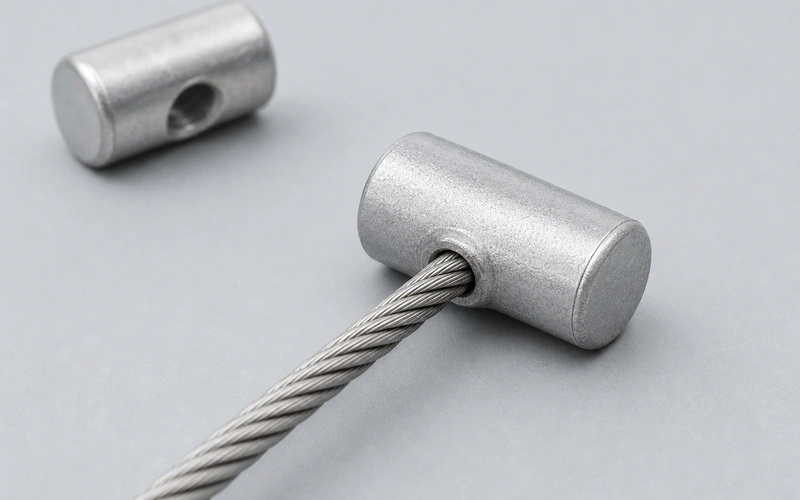
Rapid die casting in cable terminal production is a process that forms a zinc or zamak alloy fitting directly onto a wire rope end. Molten metal is injected under pressure into a reusable die. The alloy cools around the cable end and takes the shape of the die cavity. The finished terminal is ready in seconds. This method is now widely used for automotive brake cables, motorcycle and bicycle control cables, and fitness equipment cables. It also suits other push-pull cable assemblies where terminal shape and batch consistency matter.
Rapid die casting is a metal-forming process that creates a cable terminal by injecting molten zinc alloy into a closed die around a prepared wire rope end. The process follows a fixed sequence. First, the zinc or zamak alloy is melted in a crucible at around 400°C. The wire rope end is placed into the die, with the strands fanned out to form a “mushroom” shape. This fanned-out section acts as an anchor inside the casting. Once the strands are locked in place by the solidified alloy, the terminal cannot slip off the rope. Next, the machine injects molten alloy into the die cavity under pressure. The alloy fills the cavity and flows around every strand of the fanned rope end. After a short cooling period, the die opens and the finished terminal is ejected. The part then moves to an automatic deburring station, where flash and excess material are trimmed away. The full cycle takes only seconds from injection to ejection.
Zinc and zamak alloys suit cable end die casting because of three properties: low melting point, high fluidity, and fast cooling. The melting point of zamak sits around 400°C. That is low enough to avoid damaging the steel wire rope during casting. Higher-melting alloys like aluminum (around 660°C) or brass (around 900°C) would overheat the rope strands and weaken them. The high fluidity of zamak means the molten metal fills fine details in the die cavity. Thin walls, small threads, and tight radii all cast cleanly. Fast cooling shortens each cycle, which raises hourly output. Zamak is also easy to recycle. Runners and scrap from the casting process go back into the crucible, so material waste stays low.
Rapid die casting replaces manual splicing and cold swaging for medium-to-high-volume cable work. It forms the terminal in one automated step. This cuts cycle time, removes the need for pre-made fittings, and holds tighter tolerances across large batches. The following three sections break down each of those gains.
Die casting produces a finished terminal in seconds. Manual splicing is the process of weaving wire rope strands back into the rope body to form a loop or eye. It is labor-intensive and the speed depends on the operator’s skill level. Cold swaging is a process that presses a pre-made fitting onto a cable using a hydraulic press. It is faster than splicing, but still requires an operator to load the fitting, position the cable, and trigger the press for each piece. Die casting automates the forming step entirely. Once the cable end is placed in the die, the machine handles injection, cooling, ejection, and deburring with minimal human input. Over a full shift, this cuts the per-piece time and raises daily output.
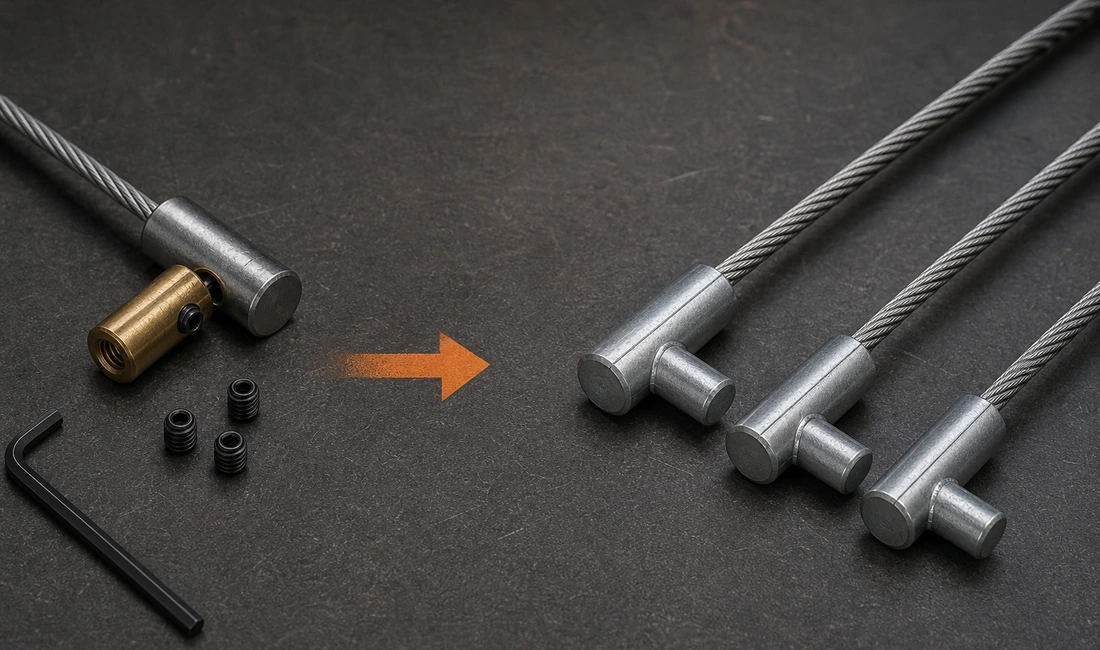
Die casting can form terminal shapes that swaging cannot. Swaging is limited to the shapes available as pre-made fittings. Common options include cylindrical sleeves, ball ends, and eyelets. Any shape outside that catalog requires a custom-machined fitting, which adds lead time and cost. Die casting creates the shape directly from the die cavity. Barrels, bullets, Z-shapes, L-shapes, threaded ends, and eyelets can all be cast in one step. The shape is defined by the mold, not by a pre-made part. Changing the terminal design only requires a new die, not a new fitting supply chain.
Die casting holds tighter tolerances than manual methods. The die controls every dimension of the terminal. Batch-to-batch variation stays within a narrow range. This reduces the number of parts rejected during quality checks and cuts rework. The per-part labor cost also drops at volume. An automated die casting cycle replaces the manual loading, fitting, and pressing steps of swaging. The machine handles deburring on its own. One operator can run the line. Material costs stay low too. Zinc alloy runners and reject parts go back into the crucible and get recast. Swaging still holds its place for low-volume work and for heavy-lift applications where the terminal must carry extreme loads. But for cable assemblies in the thousands-per-month range, die casting is the more cost-effective method.
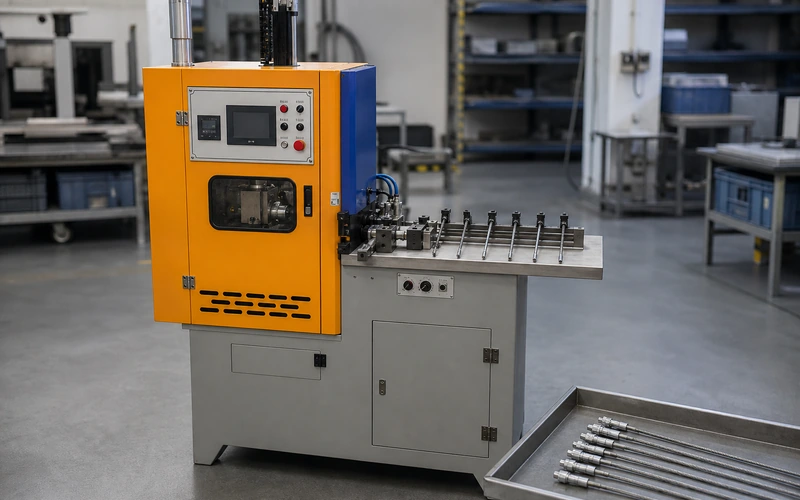
Three features separate a production-grade rapid die casting machine from a basic press. They are automated casting-to-deburring workflow, precision mold detection and temperature control, and the ability to connect with upstream and downstream cable processing stations.
Automated casting and deburring is the feature that drives the biggest productivity gain. After injection and cooling, the machine moves the part to a deburring station. It trims flash and excess material without manual handling. This keeps the operator free to load the next cable end while the previous part is being finished. A hydraulic accumulator reduces motor power draw during the cycle, which lowers energy cost per part. These features are standard on a purpose-built rapid die casting machine designed for cable terminal work.
Mold detection and temperature control are what keep reject rates low over long production runs. A mold closing detection sensor checks the gap between die halves before each shot. If the gap is out of spec, the machine stops. This prevents flash, short shots, and the size errors that come from a die that is not fully closed. A PLC-controlled temperature system holds the alloy at the right casting temperature throughout the shift. If the alloy is too cool, it will not fill fine details in the die. If it is too hot, cycle time stretches and the rope strands risk heat damage. Steady temperature means steady part quality from the first shot to the last.
A die casting machine fits between the cable preparation stage and the finishing stage. Upstream, the cable is cut to length and stripped if coated. The end is then fanned or broomed to create the anchor structure inside the terminal. Downstream, the cast terminal may go through a secondary trim, visual inspection, or pull-test before packing. In a full control cable production line, the die casting step sits alongside outer casing preparation, wire flattening, and final assembly. Keeping the die casting machine matched to the same cable diameter range as the rest of the line avoids bottlenecks and keeps throughput even.
Manufacturers should evaluate rapid die casting equipment by checking three things in order. First, whether the machine’s capacity matches the cable size and terminal shape. Second, whether the automation level fits the daily output target. Third, whether the mold system allows fast changeover for mixed orders.
Start with the cable diameter and the terminal size the manufacturer expects to produce. The die cavity must match the largest terminal in the product range. A machine that is too small will not fill the cavity fully. One that is oversized wastes cycle time and energy. Getting the right match between machine capacity and part size is the first step.
A manufacturer pressing a few hundred terminals per day may do fine with semi-automatic operation: manual cable loading, automatic injection and deburring. At thousands per day, a more integrated setup is needed — automatic feeding, casting, deburring, and part ejection. Higher automation cuts per-part labor cost but raises the upfront cost. The right level depends on current volume and where the manufacturer plans to be in two to three years.
Manufacturers that serve multiple end customers often need to cast several terminal shapes on the same machine. Fast mold changeover keeps the line productive between batches. The key question is whether the machine uses a standard mold base that accepts different cavity inserts. This allows switching terminal shapes without changing the full die set. Mold tooling carries a one-time cost. Manufacturers that plan for a family of related terminal shapes from the start can share a common mold base and reduce per-mold investment.
What terminal shapes or applications are not suited for die casting?
Die casting is not the best fit for every terminal. Heavy-lift sling terminals that must hold extreme pull-out loads at or above the rope’s full breaking strength are still better served by cold swaging. Swaged terminals have a proven load-bearing record in crane, mining, and offshore rigging work. Die casting also has limits on terminal size. Hot-chamber die casting machines used for cable work are designed around smaller cable diameters and compact terminal profiles. Larger rope diameters typically need a different forming process.
What is the minimum order volume that makes die casting more cost-effective than swaging?
Die casting requires a custom die, which has a one-time tooling cost. That cost is spread across the production run. For simple terminal shapes, die casting typically becomes cheaper per part than swaging once the order reaches the low thousands. For more complex shapes that would need a custom-machined swaged fitting, die casting can break even at lower volumes. The exact crossover depends on terminal shape, material, and cycle time.
The selection path follows a clear chain. Cable diameter sets the machine capacity. Terminal shape sets the die design. Daily volume sets the automation level. Working through these three steps gives a concrete equipment spec before any quote is requested.
Purpose-built rapid die casting lines keep casting, deburring, and quality control matched to the same cable range. The equipment BOBO Machine builds for control cable and wire rope terminal production follows this approach. Each step feeds the next without bottlenecks or rework.
For manufacturers ready to define the right setup, sharing a drawing, sample, or spec sheet is the most direct starting point. Include the target cable diameter, terminal shape, and daily volume for a matched equipment plan.