Wire Rope Swaging and Pressing: Equipment Guide for Cable Assembly Production
Jump to section
Wire rope swaging and pressing turn a cut length of cable into a finished cable assembly. A metal ferrule or fitting is pressed onto the rope under high force. This bond gives the assembly its safe working load. If the bond fails, the assembly fails. That makes pressing equipment one of the most important buys for any rigging shop or sling production facility. This guide covers how swaging and pressing work, what equipment types exist, and what specs matter most when choosing a press.
Wire rope swaging and pressing are cold-forming methods that press a metal ferrule or fitting onto a wire rope under high force. They create a permanent bond that holds the cable assembly together under load. Both reshape metal without heat. Both rely on precision tooling to control the final shape of the pressed joint. The difference lies in how the force is applied and what tooling does the work.
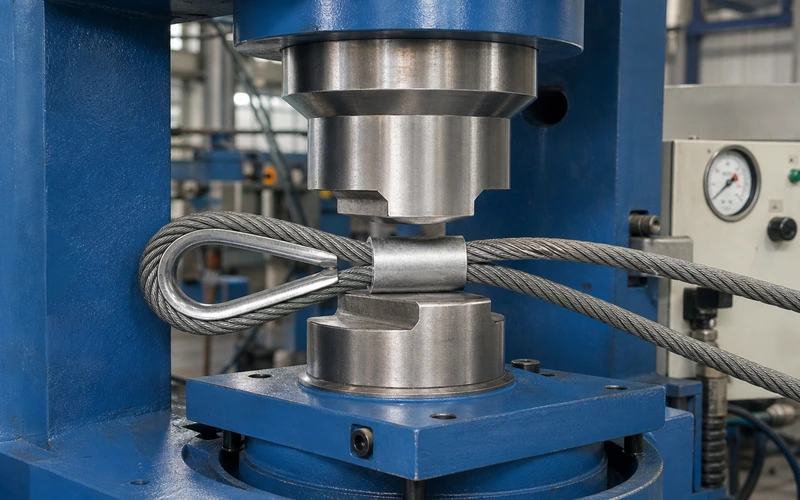
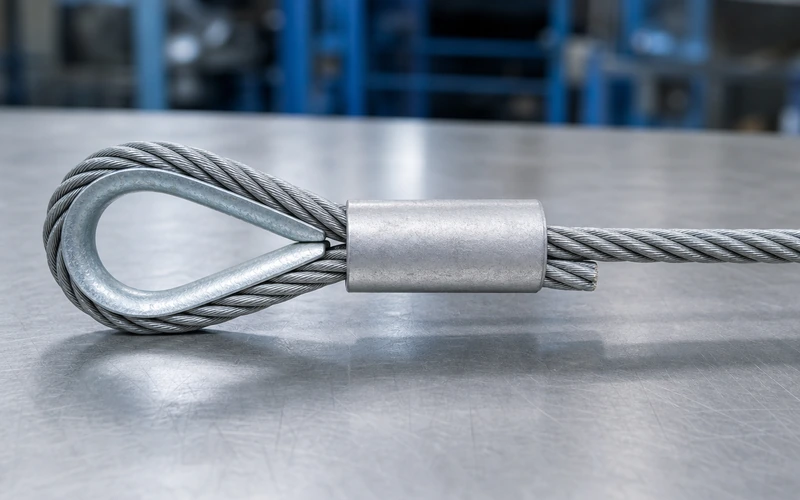
Wire rope swaging is a cold-forming process that presses a ferrule around a wire rope across the full circle of the sleeve. The ferrule material — aluminum, copper, or steel — flows into the gaps between the rope strands under pressure. This locks the ferrule to the rope. After swaging, the ferrule keeps its round shape. A good swaged joint retains about 90% of the rope’s minimum breaking strength. That high retention rate is why swaging is the go-to method for load-bearing cable assemblies in lifting, rigging, and crane systems. Common examples include wire rope slings for overhead cranes, cargo lashing assemblies, and marine mooring lines.
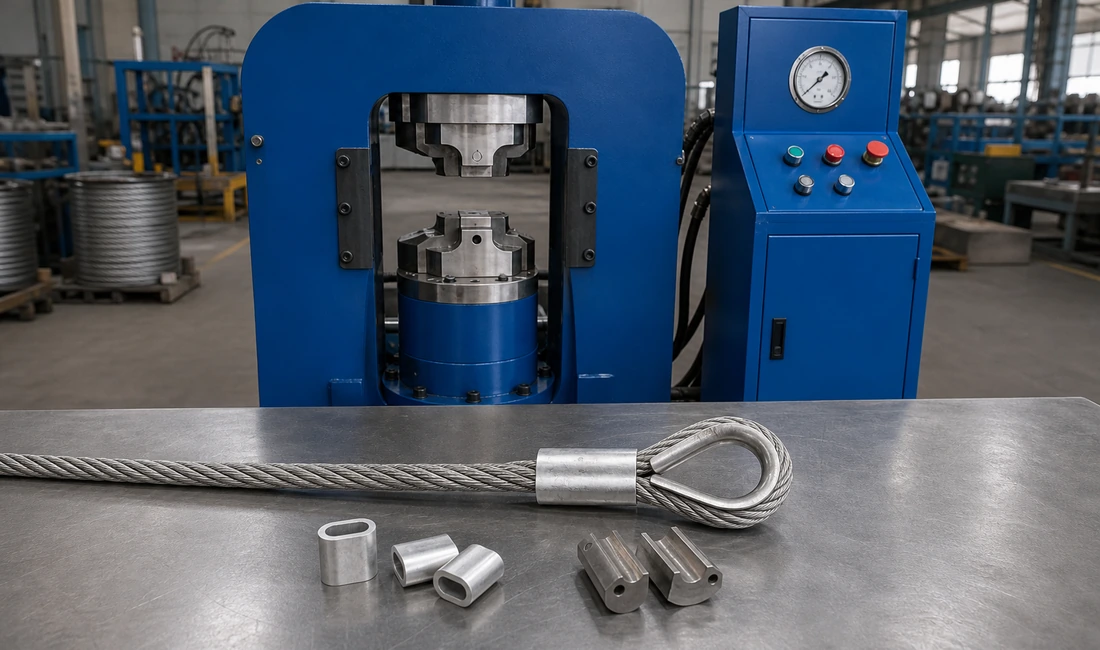
Wire rope pressing is a cold-forming process that uses a hydraulic press to close a matched pair of dies around a fitting and wire rope. The press applies force through the die halves in a single stroke. As the dies close, the fitting presses onto the rope and takes the shape of the die cavity. This method handles many fitting profiles: cylindrical sleeves, hex ferrules, and ball stops. The pressed surface comes out smooth and burr-free. Sharp edges and strand damage from manual splicing or field tools are removed.
Swaging presses a ferrule around the full circle of the wire rope. Crimping applies force at specific points. It creates dimples or dents in the sleeve rather than reshaping the whole thing. This leads to a gap in holding strength. Swaged joints hold close to 90% of the rope’s rated breaking strength. Crimped joints can hold as low as 30% to 35% for basic stop sleeves. Crimping works for light field jobs, quick repairs, and electrical wiring. Swaging and pressing are the standard for cable assemblies that must pass a certified break test. The rest of this article focuses on swaging and pressing equipment.
Wire rope swaging and pressing equipment ranges from small handheld tools to full-size hydraulic press machines. The right type depends on rope diameter, fitting type, daily output, and shop setup.
Handheld and bench-mount swaging tools are compact devices that press small ferrules and stop sleeves onto wire rope. They use manual, pneumatic, or light hydraulic force. Most handle rope up to about 5 mm. They work well for on-site rigging repairs, low-volume jobs, and light-load cables. Their main limit is force output. A hand tool cannot deliver the tonnage needed to fully press a large steel ferrule onto a thick rope. That is why volume cable assembly work needs a dedicated press. Rotary swaging machines also exist, but they reduce rope diameter rather than attach fittings. They fall outside this guide.
Hydraulic wire rope press machines are the standard for cable assembly production. A typical unit delivers 50 to 200 or more tonnes of force through a pair of matched dies. Several features set an industrial wire rope press machine apart from lighter tools.
The frame is cut from a single solid steel block, not welded from separate plates. This removes weld stress points and keeps the dies aligned under full tonnage. Good alignment means uniform crimp quality and longer die life.
The die system uses round dies with automatic positioning. Switching rope sizes takes minutes. In a mixed-order shop pressing several rope sizes per shift, fast changeover cuts downtime between batches.
The hydraulic cylinder uses combined seals with ultra-wear-resistant guide rings. This keeps pressing force steady over thousands of cycles and reduces unplanned stops. CE-certified units meet EU machinery safety rules out of the box, which matters for shops that export slings or serve regulated end markets.
Three specs decide whether a wire rope press fits a production shop: press tonnage, die design, and rope prep quality. Getting any one wrong leads to weak joints, failed break tests, or lost production time.
Press tonnage sets the upper limit on rope diameter and ferrule material. A thicker rope needs more force to press the ferrule tight enough for the metal to flow into the strand gaps. Ferrule material matters too. Aluminum deforms at lower force than copper. Steel needs far more tonnage than either. A 50-tonne press may handle aluminum ferrules on ropes up to about 10 mm. Steel ferrules on ropes above 20 mm can need 150 to 200 tonnes or more. Picking a press with enough headroom for the largest rope-and-ferrule pair avoids the need for a second machine later. As a rule, it is better to have spare tonnage than to run at the machine’s upper limit on every cycle. Running at peak force shortens seal and die life.
Die profile must match the fitting. Common profiles include round, hex, and cylindrical cavity shapes. Each one creates a different finished shape on the ferrule. The wrong die profile causes uneven pressing. That weakens the bond and can make the joint fail under load.
Changeover speed matters when a shop presses several fitting types or rope sizes per shift. A round die with automatic positioning seats itself right every time. It cuts changeover to a few minutes. A press that needs manual shimming or trial runs to center each new die set wastes time on every switch.
Poor cutting is one of the most common causes of pressing defects. A frayed, burred, or angled rope end will not seat fully inside the fitting. That leaves a short grip length inside the ferrule. A short grip means lower holding strength. In break tests, short-seated assemblies often fail well below the rope’s rated capacity.
Sharp-blade cutting gives a clean, square end on most steel and galvanized ropes. Fuse cutting seals the strand ends with heat, which stops fraying during fitting insertion. Both methods work, but each suits different rope types. The cutting step matters as much as the press itself. That is why many sling lines pair a press with a cutting station from the same wire rope processing machine lineup. That lineup includes cutting, melting, and annealing gear sized for the same rope range.
Fabricators should work through three factors in order. First, the rope sizes and fitting types the shop needs to cover. Second, the daily output target. Third, the safety certifications the end market requires. Skipping any step risks buying a machine that cannot do the job or meet compliance rules.
Start with the largest rope and the hardest ferrule material the shop expects to press. That pair sets the minimum tonnage. Then check that the die set covers every fitting profile on the order book: cylindrical sleeves, hex fittings, stop sleeves, and others. A press that covers the full range on day one avoids rush tooling orders later.
A small workshop pressing a few dozen slings per week has different needs from a plant making thousands per month. For lower volumes, a standalone press with foot-pedal control and manual loading is enough. For higher volumes, cycle-time features matter. Variable-speed hydraulics allow fast approach and slow final pressing. Preset pressure shutoff opens the dies once the target force is reached. These features save seconds per cycle. Over a full shift, those seconds add up.
Different end markets have different rules. Lifting and rigging in Europe typically require CE-certified equipment. Mining and offshore may require full traceability from raw material to finished sling. A press with a built-in pressure gauge and cycle logging makes record-keeping easier. Checking these rules before buying avoids the risk of owning a press that makes good slings but cannot prove it on paper.
What quality checks should follow each wire rope pressing cycle?
Three checks. First, inspect the ferrule surface for cracks, uneven pressing, or strand damage. Second, measure the pressed outer diameter with a caliper and compare it to the die maker’s target value. Third, run periodic break tests on sample assemblies. Test frequency depends on the end market. Lifting and rigging jobs typically need a higher sampling rate.
Can a fabricator start with one press and scale up later?
Yes. Many shops begin with one hydraulic press for their core rope range. As orders grow, they add a cutting and winding machine for precise lengths and a melting or annealing machine for clean end prep. Starting with one press and growing step by step keeps the entry cost lower while still building toward a complete line.
Most cable assembly quality problems trace back to a short list: wrong tonnage, poor die match, or a bad cut that keeps the rope from seating fully. Getting the press setup right from the start prevents rework and failed break tests.
It helps just as much to pair the press with the right upstream equipment. Purpose-built wire rope processing lines — like the cutting, melting, annealing, and pressing equipment BOBO Machine builds — keep each step matched to the same rope range, so quality stays consistent from the first cut to the final pressed sling.
For fabricators ready to define the right setup, sharing a drawing, sample, or spec sheet with the target rope range and daily volume is the most direct way to get a matched equipment plan.