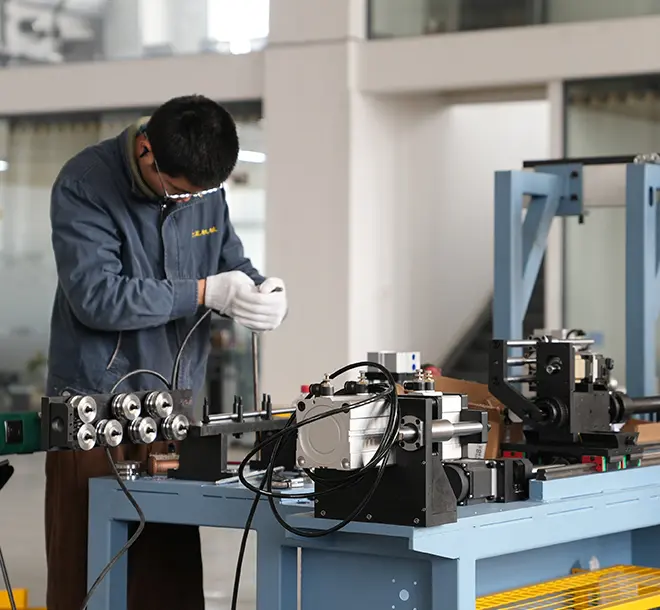
Wire Harness Cutting & Stripping: Manual vs Semi-Auto vs Fully Automatic — Choosing the Right Automation Level
Jump to section
Wire harness manufacturers must choose between manual tools, semi-automatic machines, or fully automatic systems for processing wires. Each automation level offers different trade-offs in speed, cost, flexibility, and precision—manual processing costs $5,000 to $15,000 to set up but handles only 80 to 200 wires per hour, while fully automatic systems process up to 4,000 wires per hour but require $300,000 to $600,000 in upfront investment. The decision depends on production volume, product variety, and budget.
This article explains how each automation level works and compares their performance across key metrics. It covers the specific advantages and disadvantages of manual, semi-automatic, and fully automatic cutting and stripping systems. Readers will learn which option fits different production scenarios, from prototype builds to high-volume manufacturing.
The guide also provides a decision framework based on product complexity, expected volume, and workforce considerations. It includes real-world examples of hybrid approaches that combine automation levels within the same production line.
Wire harness cutting and stripping prepares wires for terminal attachment by cutting them to length and removing insulation from the ends. The process exists in three forms: manual (hand tools), semi-automatic (machine-assisted), and fully automatic (end-to-end machine processing).
Cutting and stripping is the first step in wire harness manufacturing. Machines or operators cut wires to specific lengths based on the harness design. Strip lengths typically range from 2mm to 15mm depending on the terminal type.
The cutting process must maintain tolerances of ±2mm or tighter for most automotive applications. Poor cut quality creates frayed wire ends that jam terminals or prevent proper crimping.
Stripping removes the insulation jacket from both wire ends without damaging the conductor strands beneath. Damaged strands reduce the wire’s current-carrying capacity and weaken the crimp connection. Nicked conductors can break during crimping or vibration testing.
Clean strip quality prevents insulation fragments from entering the crimp barrel. These fragments block metal-to-metal contact between the wire and terminal, causing electrical resistance or connection failure.
Manual processing uses handheld wire strippers and cutting tools. Operators measure each wire length, cut it, then strip both ends by hand. This method requires no machine investment but produces 20-40 wires per hour per operator.
Semi-automatic machines handle either cutting or stripping while operators load wire and remove finished pieces. The operator feeds wire into the machine, which cuts to programmed length and strips one or both ends. Production reaches 200-600 wires per hour depending on wire gauge and strip length.
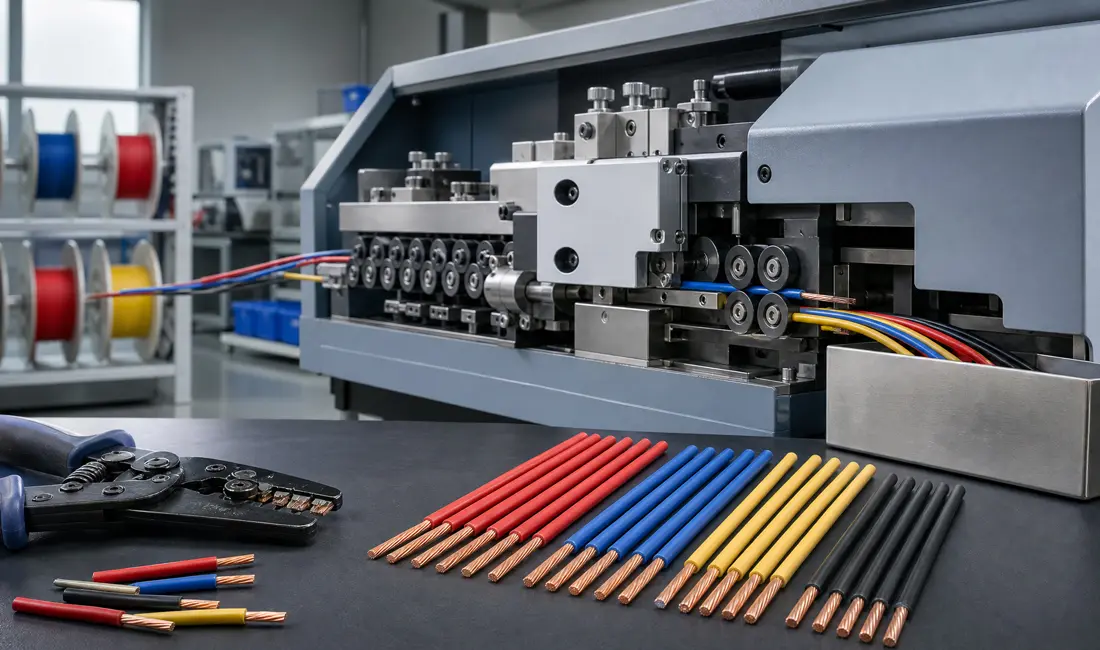
Fully automatic systems process wire from bulk spools through cutting, stripping, and often crimping without operator intervention between cycles. These machines cut, strip both ends, verify strip quality, and eject finished wires into collection bins. Output ranges from 3,000 to 8,000 wires per hour for standard automotive wire gauges.
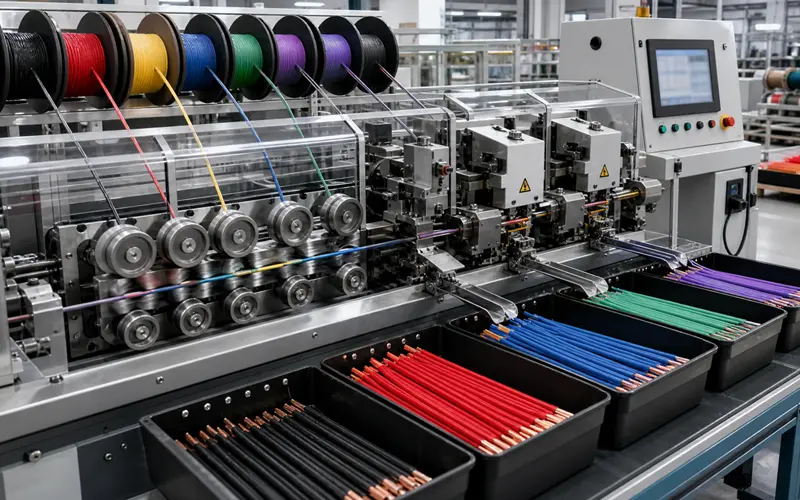
The three types differ in how much human effort they require and how much the machine controls the process. Manual tools require operators to position, adjust, and strip each wire by hand. Semi-automatic machines handle cutting and stripping with preset measurements but still need human loading and unloading. Fully automatic systems perform every step from feeding to stripping without operator intervention between cycles.
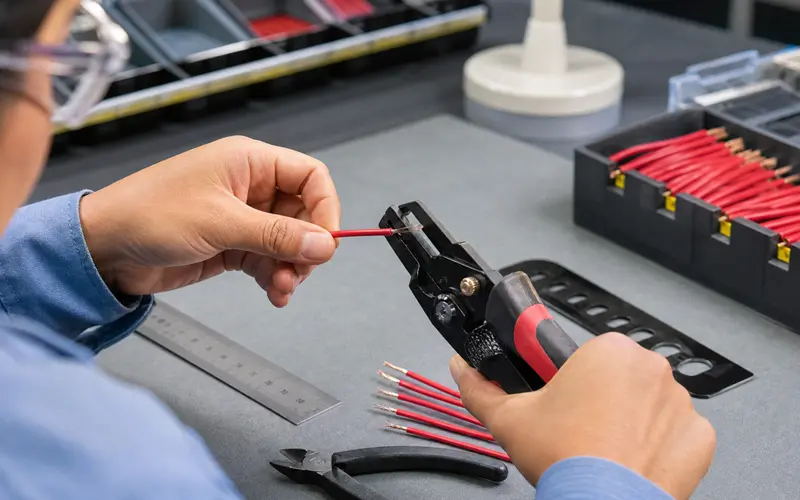
Manual wire strippers require operators to insert each wire into the tool and apply physical force to remove insulation. The operator selects a stripping slot that matches the wire gauge, positions the wire at the correct length, and squeezes the handles to cut through the insulation.
The tool strips only the outer layer while leaving the conductor intact. Operators must measure and mark cut lengths themselves before processing each wire. This method works for low-volume jobs where setup time for automated equipment would exceed the actual processing time.
Manual tools create three common problems:
The process takes 15 to 30 seconds per wire depending on operator skill. Small shops processing under 100 wires per day typically use manual tools because the equipment cost stays under $50.
Semi-automatic machines cut and strip wire to preset specifications after an operator loads each piece. The operator sets the cut length and strip length once, then feeds individual wires into the machine for processing. The machine measures, cuts, and strips each wire in 2 to 5 seconds.
These machines adjust blade depth automatically based on wire diameter sensors. The operator removes the finished wire and loads the next one. Changeovers between different wire types take 5 to 15 minutes to adjust settings and blade positions.
Semi-automatic equipment handles 500 to 2,000 wires per day with one operator. The machines cost between $500 and $5,000 depending on features like programmable length memory and multiple strip position capability. Shops running moderate production volumes choose this option when they process 3 to 10 different wire specifications daily.
Fully automatic systems feed wire from spools, measure lengths, cut, strip both ends, and collect finished pieces without manual handling. Operators load wire spools and input specifications through a digital interface. The machine processes continuous runs until the spool empties or the batch completes.
These systems include sensors that detect wire diameter and adjust cutting depth in real time. Advanced models add crimping terminals, inserting seals, and quality inspection to the same cycle. Production rates reach 3,000 to 10,000 pieces per hour depending on wire complexity and length.
The equipment costs $10,000 to $100,000 based on capabilities. Changeover between wire types takes 1 to 3 minutes through saved digital profiles. Manufacturers processing over 5,000 wires daily gain cost advantages from fully automatic systems despite the higher initial investment.
Manual processing requires minimal investment but relies on operator skill and speed. Semi-automatic systems balance flexibility with consistency through human-machine interaction. Fully automatic lines deliver maximum throughput and precision but demand high capital and suit only stable, high-volume production.
Manual processing costs between $5,000 and $15,000 for basic benches, hand tools, and testers. This low barrier to entry makes it accessible for startups and low-volume shops.
Operators control every cut and strip manually. This gives complete flexibility for prototype work, custom builds, and frequent design changes. No programming or changeover time is needed.
Key advantages:
Key disadvantages:
Manual methods work best for volumes under 100 harnesses per day or when product variation is extremely high.
Semi-automatic machines start around $80,000 and automate precision-critical steps while operators handle loading, verification, and positioning. These systems combine speed with adaptability.
Changeover times stay short compared to fully automatic lines. Operators can switch between wire types or terminal sizes in minutes rather than hours. This makes semi-automatic processing ideal for high-mix, medium-volume environments.
Key advantages:
Key disadvantages:
Semi-automatic systems deliver the best return on investment for volumes between 100 and 1,000 harnesses per day with moderate product variation.
Fully automatic lines cost between $300,000 and $600,000 or more. These systems handle cutting, stripping, crimping, and quality checks with minimal human input.
Processing speed exceeds manual methods by significant margins. Automotive suppliers running high-volume production see the clearest payoff.
Key advantages:
Key disadvantages:
Fully automatic processing works best when volumes exceed 1,000 harnesses per day and product designs remain stable for extended periods.
The right automation level depends on production volume, wire complexity, and budget constraints. Small operations with under 500 cuts per day can justify manual tools, while production runs exceeding 5,000 cuts per day require fully automatic systems.
Production volume dictates the baseline automation requirement. Manual machines handle 50-200 cuts per hour. Semi-automatic systems process 300-800 cuts per hour. Fully automatic machines complete 1,000-3,000 cuts per hour.
Wire gauge range affects equipment selection. Manual strippers work with limited wire sizes, typically 10-24 AWG. Semi-automatic machines accommodate 10-30 AWG. Fully automatic systems process the widest range, from 8-32 AWG with quick changeovers.
Precision requirements impact the choice. Manual operations achieve ±0.5mm tolerance. Semi-automatic machines deliver ±0.2mm consistency. Fully automatic systems maintain ±0.1mm precision with sensors and programmable controls.
Labor costs change the equation. A manual operator earning $20 per hour produces 150 cuts hourly, costing $0.13 per cut. Semi-automatic operation drops this to $0.05 per cut. Fully automatic systems reduce labor cost to under $0.02 per cut.
Budget allocation matters:
Choose manual machines for prototype work, repair operations, and businesses processing fewer than 500 wires daily. These tools require no programming knowledge and fit into mobile toolkits. Manual strippers excel when wire specifications change frequently across small batches.
Select semi-automatic machines when daily production reaches 500-5,000 wires. These systems suit growing manufacturers who need consistent quality without six-figure investments. Semi-automatic equipment works well for operations with 2-5 wire types and moderate complexity. The machines reduce operator fatigue while maintaining flexibility for specification changes.
Pick fully automatic systems when production exceeds 5,000 wires daily or when precision under ±0.1mm is mandatory. Automotive, aerospace, and medical device manufacturers require this automation level. Fully automatic machines justify their cost when labor represents more than 40% of wire processing expenses. These systems handle cutting, stripping, crimping, and sealing in one continuous process without operator intervention between cycles.
Start with manual tools for initial production and testing. This requires minimal capital and helps manufacturers understand process needs. Manual operation highlights bottlenecks and quality issues before investing in automation.
Add semi-automatic machines when monthly volume reaches 10,000 units. Purchase one semi-automatic unit for the most common wire specifications. Keep manual tools for low-volume or specialty wires. This hybrid approach spreads costs and boosts throughput for high-volume products.
Transition to fully automatic systems after 12+ months of consistent demand. Use production data from semi-automatic operations to select the right fully automatic machine. Keep semi-automatic equipment as backup and for prototypes.
Deploy modular automation in stages. Install automatic cutting first, then add automatic stripping and crimping modules. Each module costs $8,000-$15,000, compared to $50,000+ for a complete system. This staged approach maintains production during upgrades and matches investment to revenue growth.
Semi-automatic equipment is cost-effective at 5,000-10,000 units per year for identical wire types. Manual cutting processes 50-100 wires per hour, while semi-automatic systems handle 500-1,500 wires per hour. Manual setups cost $5,000-$15,000, while semi-automatic machines cost $50,000-$150,000.
Break-even calculations should include changeover time between wire types. Semi-automatic equipment requires 15-30 minutes for changeover, compared to 2-5 minutes for manual operations. Manufacturers producing many wire types in small batches often lose productivity to setup time.
Labor cost is the main driver for automation. Semi-automatic equipment reduces direct labor costs by 60-80% per wire. A manual operator earning $20 per hour produces 75 wires hourly at $0.27 per wire, while semi-automatic equipment produces 1,000 wires per hour at $0.06 per wire with one operator.
Fully automatic machines achieve 99.9% repeatability on strip length within ±0.5mm. Semi-automatic systems deliver 98-99% accuracy within ±1-2mm. Manual stripping varies ±3-5mm depending on operator skill. Conductor damage occurs in 3-8% of manual strips, 1-3% of semi-automatic strips, and 0.1-0.5% of fully automatic strips.
Fully automatic equipment includes real-time crimp height monitors and pull-force verification to catch defects before assembly. Semi-automatic machines require operator inspection and manual blade adjustment every 5,000-10,000 cycles.
Wire type consistency affects both methods. Fully automatic systems require frequent recalibration for different materials like PVC, Teflon, and silicone insulation. Semi-automatic equipment lets operators adjust blade pressure and strip speed between wires without programming changes.
Wire gauge range affects equipment capability and cost. Manual tools handle 10-30 AWG, semi-automatic systems process 8-26 AWG, and fully automatic machines work with 6-30 AWG depending on the model. Equipment for 22-30 AWG costs $30,000-$80,000, while machines for 6-20 AWG range from $100,000-$300,000.
Insulation material hardness affects blade life and strip quality. Teflon and cross-linked polyethylene need carbide or ceramic blades that last 50,000-100,000 cycles. Standard PVC insulation allows for 200,000-500,000 cycles. Automatic systems use pressure sensors and adaptive blade positioning to adjust for material differences.
Shielded and jacketed cables need specialized stripping heads. Single-conductor PVC wire strips cleanly on any equipment, while coaxial cables and shielded twisted pairs require programmable multi-step stripping. Fully automatic machines can manage complex strip patterns, such as partial jacket removal and shield folding, without operator help.
Jacket thickness variation within a production run creates problems for semi-automatic equipment. Manual operators adjust blade depth by feel, while fully automatic systems use laser or capacitive sensors to detect insulation thickness before cutting. Semi-automatic machines need operator checks and manual adjustment if jacket thickness varies more than ±0.2mm from specifications.