Flexible Duct Manufacturing: Insulated vs Non-Insulated Production
Jump to section
HVAC workshops choose between two production paths for flexible duct: insulated and non-insulated. The choice changes materials, line layout, equipment count, and certifications. Insulated duct uses three layers including fiberglass insulation and a vapor barrier jacket. Non-insulated duct uses a single layer over a wire helix. Six equipment categories cover non-insulated production, and two cover insulated and multi-layer production. The right configuration depends on target market, R-value requirements, UL classification, and output goals. This article maps the duct types, the production equipment, the workflow differences, and the trade-offs between both paths.
A flexible duct is a bendable air duct that connects rigid trunks with diffusers, registers, and HVAC equipment. Insulation controls condensation, cuts thermal loss in unconditioned spaces, and lowers airflow noise inside ceilings.
Flexible duct sits between the rigid trunk and the room diffuser. Workshops add insulation when the duct passes through attics, garages, or crawl spaces. Conditioned air would otherwise lose energy and risk surface condensation in those spaces. Factory-made flexible ducts carry the UL 181 Class 1 listing for fire safety.
HVAC workshops produce three flexible duct types: insulated, non-insulated, and semi-rigid. UL 181 also splits each type into Air Ducts and Air Connectors based on safety testing.
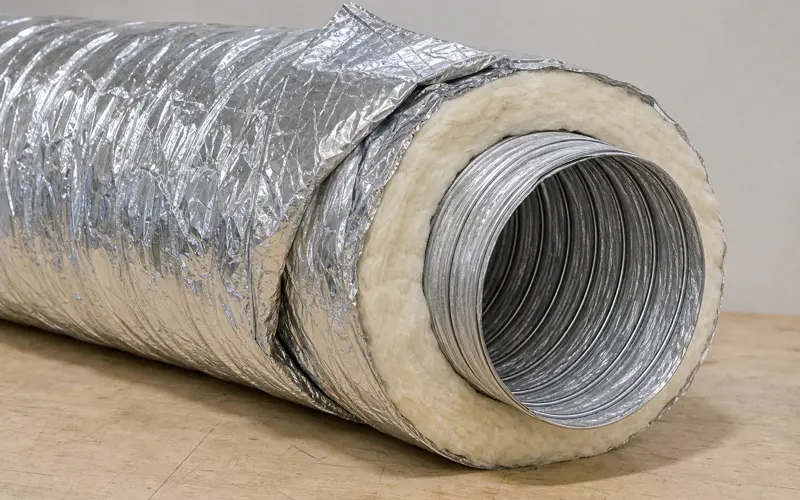
An insulated flexible duct is a three-layer duct that combines an inner liner, fiberglass insulation, and a vapor barrier jacket.
Insulated flexible duct serves residential and commercial supply lines passing through unconditioned spaces. The R-value tier — R-4.2, R-6, or R-8 — appears on the outer jacket and the listing label.
A non-insulated flexible duct is a single-layer duct that uses foil, film, or stainless steel over a wire helix.
Applications include exhaust, return air, kitchen ventilation, dryer venting, and industrial fume extraction. These ducts are lighter, cheaper to produce, and easier to bend than insulated versions.
A semi-rigid flexible duct is a corrugated metal duct that holds the bent shape set by the installer.
Semi-rigid duct fills the gap between fully flexible ducts and rigid fittings. It works best in retrofit projects with tight space.
An Air Duct is a UL 181-listed duct that has passed flame, puncture, and impact testing. An Air Connector is a duct that has not passed those tests.
Air Ducts carry a rectangular UL listing label. Air Connectors carry a round UL label and have a 14-foot maximum installed length. Commercial HVAC supply contracts specify Air Duct grade.
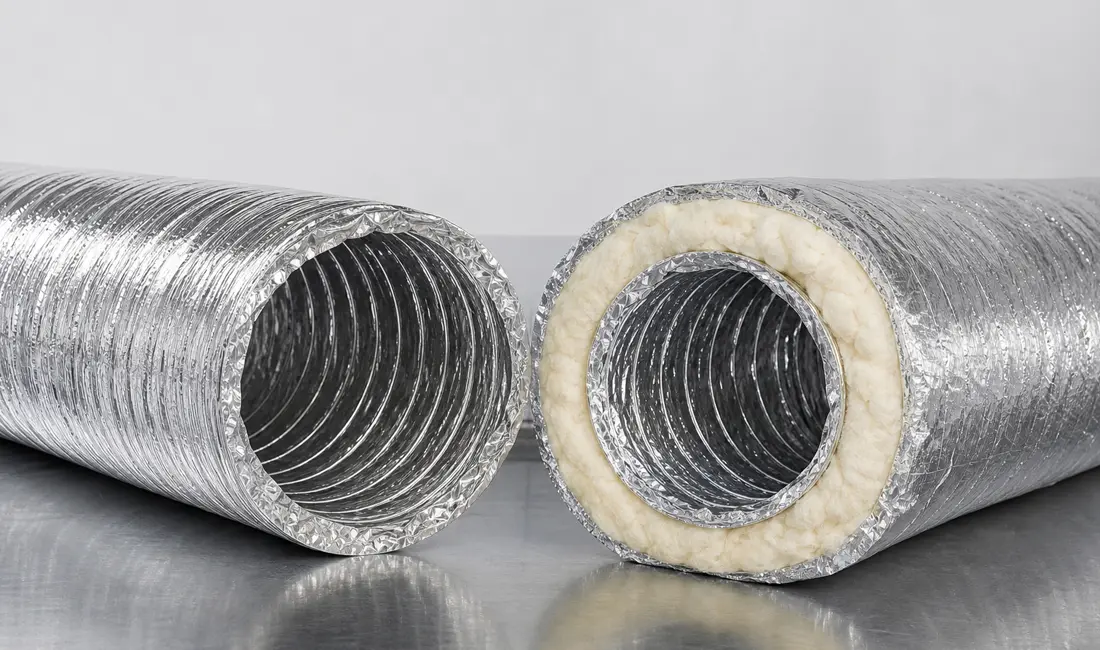
Insulated flexible duct uses three layers: inner liner, fiberglass insulation, and outer vapor barrier. Non-insulated flexible duct uses one layer over a wire helix. The two differ in R-value, condensation control, weight, manufacturing speed, and equipment count.
The table below shows the key differences between insulated and non-insulated flexible duct.
| Attribute | Insulated Flexible Duct | Non-Insulated Flexible Duct |
| Layer count | 3 | 1 |
| Insulation core | Fiberglass blanket | None |
| R-value tier | R-4.2, R-6, or R-8 | Essentially zero |
| Condensation control | Strong | Weak |
| Acoustic dampening | Significant | Negligible |
| Outer jacket | Vapor barrier with optional scrim | Foil or PVC only |
| Weight per linear meter | Higher | Lower |
| Production line stations | Three or more | Single forming pass |
| Typical UL 181 listing | Class 1 Air Duct | Class 1 Air Duct or Air Connector |
Insulated flexible duct fits three scenarios. The supply line passes through an attic, crawl space, or garage. The project specifies an R-value tier. The route runs through noise-sensitive spaces like bedrooms or healthcare areas.
Non-insulated flexible duct fits exhaust, return, and fume extraction in low-temperature-differential spaces. Uses include commercial kitchens, dryer vents, industrial ventilation, and ducts inside a fully conditioned envelope.
Six equipment categories produce non-insulated flexible duct: aluminum forming, aluminum making, semi-rigid aluminum, semi-rigid stainless steel, perforated aluminum, and high-temperature clip machines. Each handles a specific material, diameter, and temperature class.
A flexible aluminum duct forming machine is equipment that winds aluminum strip and a steel wire helix into a thin-wall airway. The AFD-600s model covers 75 to 600 mm diameters for residential and light commercial HVAC.
A flexible aluminum duct making machine is equipment that winds a wire helix and aluminum foil into single-layer flexible duct. It serves general HVAC air distribution and exhaust applications across a wide diameter range.
A flexible semi-rigid aluminum duct machine is equipment that forms corrugated aluminum strip into semi-rigid duct. The corrugated profile lets the duct hold installer-set bends in compact HVAC pathways.
A semi-rigid stainless steel duct machine is equipment that forms corrugated stainless steel strip into semi-rigid flexible duct. It handles high-temperature exhaust, fume extraction, and corrosion-prone routes such as commercial kitchens.
A perforated aluminum flexible duct machine is equipment that winds a wire helix with perforated foil into flexible duct. The perforated wall serves as an air diffusion sleeve in textile-style air distribution and acoustic-sensitive ventilation.
A high temperature flexible clip air duct machine is equipment that locks clip-formed metal strip into high-temperature-resistant flexible duct. The PFD-600/1000 model line covers two industrial diameter classes for exhaust, smoke extraction, and elevated-temperature ventilation.
Two equipment categories produce insulated and multi-layer flexible duct. Double-layer aluminum duct machines build a cavity for fiberglass insulation. PVC wire-reinforced machines produce a core that downstream wrapping lines turn into insulated supply duct.
A double layer flexible aluminum duct machine is equipment that winds an inner liner, wire helix, and outer aluminum jacket together. The two layers create a cavity that downstream stations fill with fiberglass insulation. The cavity width determines the final R-value.
A PVC flexible duct machine is equipment that bonds PVC film around a steel wire helix to form a wire-reinforced airway. The output can serve as non-insulated duct directly. It can also pair with a downstream wrapping line for insulated supply duct production.
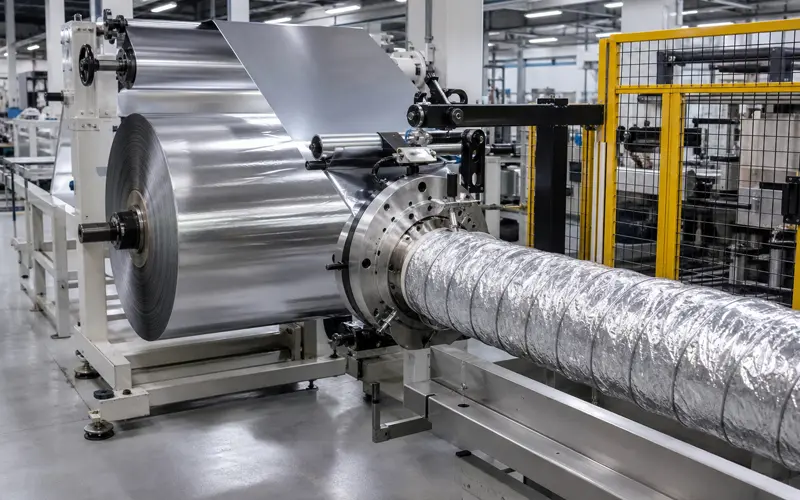
Non-insulated flexible duct uses one forming pass that combines a wire helix with foil or PVC strip. Insulated flexible duct adds two stations: fiberglass wrapping and outer vapor barrier winding.
Both production lines start the same way. A wire payoff feeds a steel helix, and a strip payoff feeds the inner liner. Heat or adhesive bonds the inner liner overlap as the duct rotates and advances. The non-insulated line moves directly to length cutting and compression coiling.
The insulated line adds two steps in the middle. A fiberglass blanket wraps the inner core with overlap. The overlap prevents radial gaps when the duct bends. An outer vapor barrier jacket then wraps the fiberglass. The jacket uses metallized polyester or polyethylene with optional scrim reinforcement. Heat seals the helical seam. The line ends with length cutting and compression coiling. Cartons and bags are larger because of the added insulation volume.
Insulated flexible duct manufacturing earns higher margins and meets supply-line code requirements. It also costs more, takes more floor space, and demands stricter material handling. Non-insulated manufacturing runs faster, costs less to set up, and is easier to maintain.
Insulated production has four commercial advantages. Unit price is higher than non-insulated. The workshop can bid on commercial HVAC supply contracts. Vapor barrier protection prevents condensation damage in humid climates. Acoustic dampening lowers fan noise in occupied spaces. The trade-offs include three constraints. The line needs more floor space. Fiberglass handling requires dust control and operator protection. The outer jacket seam needs tighter tension control.
Non-insulated production has three commercial advantages. Setup is faster and recovers capital quickly. The line runs at higher speeds and costs less per linear meter. It serves exhaust, kitchen ventilation, and industrial extraction markets. The trade-offs include two constraints. Unit price and margin are lower than insulated. The workshop cannot bid on commercial HVAC supply contracts that require R-value compliance.
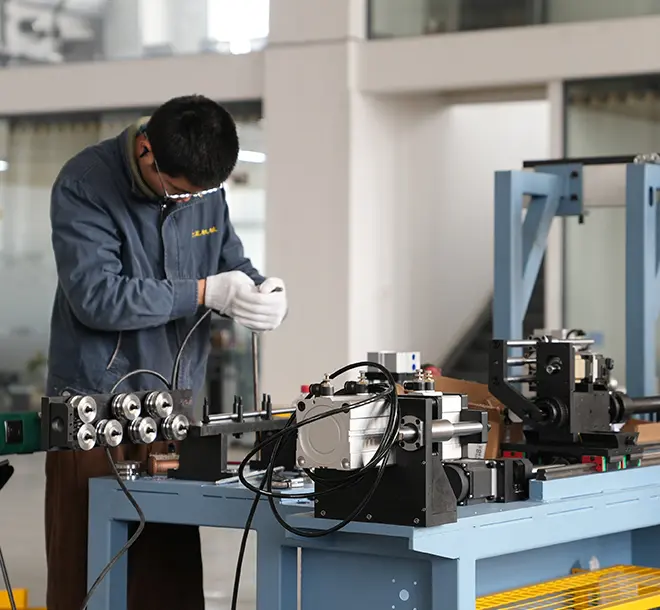
Equipment selection depends on target market, duct type, diameter, material, temperature, R-value, UL classification, and output. Workshops should map customer demand to non-insulated machines, the insulated double-layer machine, or a combined cell.
The list below shows the main decision factors before issuing an equipment specification.
Once these attributes are listed, the right configuration becomes clear. A non-insulated cell suits exhaust and kitchen markets. The double layer machine paired with a fiberglass and vapor barrier wrapping line suits commercial HVAC supply contracts. A combined cell suits export OEM workshops with seasonal order swings.
Factory-made flexible duct manufacturing follows UL 181 for the duct. UL 181A and UL 181B cover closures. NFPA 90A covers commercial installation, and NFPA 90B covers residential installation. ASHRAE 90.1, IECC, and IRC set minimum R-values for ducts in unconditioned spaces. The Air Diffusion Council publishes performance and installation standards that HVAC specifications reference.
Three R-value tiers cover residential and light commercial HVAC: R-4.2, R-6, and R-8. R-4.2 meets the baseline energy code requirement. R-6 covers mid-range supply applications. R-8 is required for severely unconditioned spaces or when the local energy code calls for it.
An Air Duct has passed UL 181 testing for flame penetration, puncture, and impact. It has no installed length limit. An Air Connector has not passed those tests. Its maximum installed length is 14 feet. Commercial HVAC supply specifications require Air Duct grade.
Factory-made flexible ducts are rated for 10 inches of water column positive pressure for diameters under 10 inches. The rating drops for larger diameters. Negative pressure ratings range from 0.75 to 3 inches of water column. The upper velocity limit is 5500 feet per minute. Diameter ranges span 3 to 22 inches.