
How to Pick the Right Gauge for Spiral Duct Manufacturing
Jump to section
A spiral duct manufacturer faces a 2-to-3-times cost difference between 26 and 16 gauge for the same run. Picking the right gauge controls steel consumption, pressure rating, leakage class, and equipment wear all at once. The wrong choice fails compliance tests or burns through margin on overspec material.
Gauge selection depends on seven variables: diameter, pressure direction, pressure class, material, wall construction, environment, and local code. Spiral lock-seam and corrugation add a second optimization layer. Together they can drop the required gauge by one full step. This guide covers each factor, the gauge charts, application-specific ranges, machine specifications, and compliance test methods.
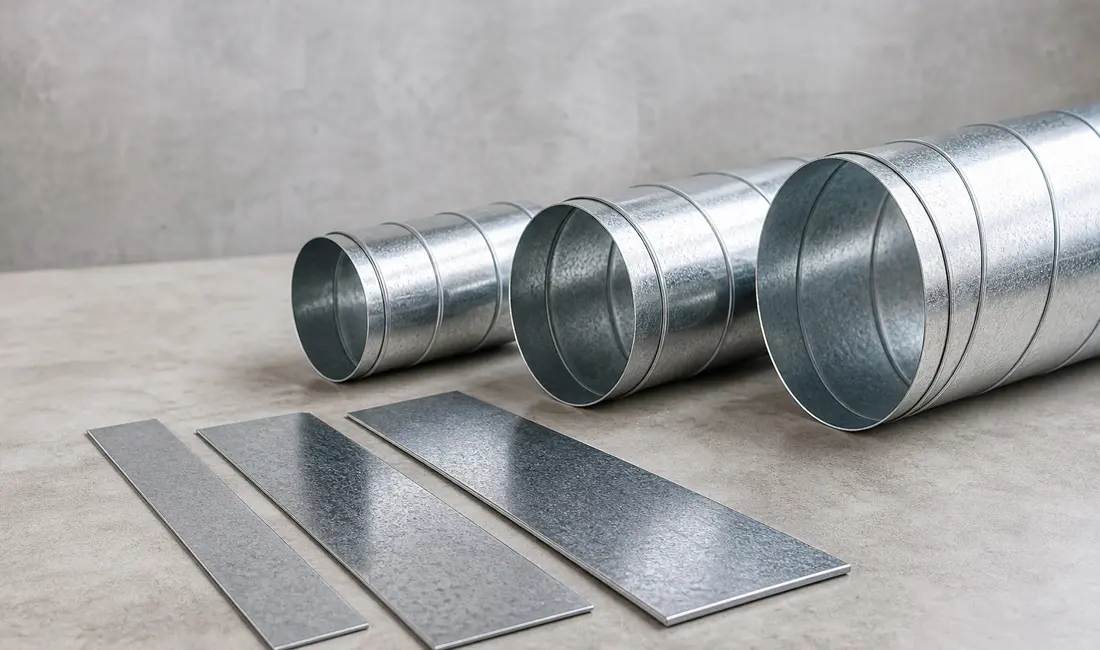
Gauge is a sheet metal thickness measurement that defines how thick the coil used in spiral duct production is. Lower numbers mean thicker steel. Spiral duct manufacturing operates within a 26 to 16 gauge range across galvanized, stainless, and aluminum sheet.
A 26-gauge galvanized sheet measures 0.0179 inches. An 18-gauge sheet measures 0.0478 inches. The same gauge number maps to different actual thicknesses across galvanized steel, stainless steel, and aluminum.
Gauge controls four product properties at once. It sets rigidity against negative pressure, sets the pressure rating under positive load, sets the duct’s running weight, and sets the raw material cost per linear foot. Every gauge decision moves all four numbers together.
The right gauge is determined by seven factors acting together: diameter, pressure direction, pressure class, material, wall construction, environment, and code. Each factor sets a minimum thickness threshold. The final gauge must satisfy all of them.
The seven factors are listed below in the order manufacturers should evaluate them.
Negative pressure changes the gauge logic. Under vacuum, the duct can collapse before it leaks. Industry tables for −2″, −4″, and −10″ water gauge often require thicker sheet at small diameters than the matching positive pressure class.
Double-wall construction shifts the load. The outer shell of an insulated spiral duct carries the structural load while the inner liner handles acoustics and condensation. Gauge selection focuses on the outer shell, while the inner liner stays thin.
Local commercial codes can require a minimum gauge stricter than industry tables. Some North American jurisdictions require 26 gauge floor regardless of pressure class. The local code must be checked before reading any gauge chart.
Industry gauge charts assign a minimum gauge to each combination of duct diameter and pressure class. They are the starting point for every gauge decision. Manufacturers read them by locating the diameter band first, then the pressure column.
The general pattern for galvanized spiral duct under positive pressure is summarized in the table below.
| Diameter Range | +2″ w.g. | +4″ w.g. | +10″ w.g. |
| 3″ – 8″ | 28 ga | 26 ga | 24 ga |
| 9″ – 14″ | 26 ga | 26 ga | 22 ga |
| 15″ – 26″ | 24 ga | 22 ga | 20 ga |
| 27″ – 36″ | 22 ga | 20 ga | 18 ga |
| 37″ – 50″ | 20 ga | 18 ga | 16 ga |
| 51″ – 60″ | 18 ga | 16 ga | 16 ga |
The reading sequence has four steps. First, identify the pressure direction. Second, identify the pressure class. Third, locate the diameter band. Fourth, read the minimum gauge from the cell. Material and environment add modifiers after.
Spiral lock-seam and corrugation both increase rigidity, which lets the manufacturer use a lighter gauge at the same pressure rating. The four-ply spiral lock-seam adds 20% rigidity over a longitudinal welded seam. Corrugation adds further crushing resistance.
The four-ply seam runs as a continuous reinforcing rib along the outside of the duct. This rib carries hoop stress, which is the dominant failure mode in round duct under pressure. A spiral duct rated for +10″ w.g. uses a lighter gauge than a longitudinal-seam pipe of the same diameter.
Corrugation adds bending resistance around the circumference. It can drop the required gauge by one full step at the same pressure rating. Galvanized spiral duct of 6 inches and larger is corrugated by default for this reason.
Reinforcement rings restore rigidity when a manufacturer wants lighter gauge for cost reasons. External angle rings welded at fixed intervals carry the bending load that thicker sheet would have carried. Industry tables specify ring size and spacing for each gauge step lighter than baseline.
Spiral duct manufacturing uses gauges from 26 down to 16, with each material setting its own minimum. The 26 to 22 range covers most commercial HVAC work. The 20 to 16 range covers industrial ventilation, dust collection, and high-pressure systems.
26 to 22 gauge covers most commercial HVAC supply and return air. 26 gauge fits diameters under 14 inches at +2″ w.g. 24 gauge fits 15 to 26 inches at +2″ w.g. 22 gauge fits 15 to 26 inches at +4″ w.g.
20 to 16 gauge covers industrial ventilation, dust collection, and large-diameter high-pressure systems. 20 gauge handles 27 to 36 inches at +4″ w.g. 18 gauge handles 37 to 50 inches at +10″ w.g. 16 gauge covers anything 51 inches and larger at +10″ w.g.
Material type sets a separate minimum that overrides the diameter chart in many cases. Common minimums by material are listed below.
Galvanized G90 steel is the default in commercial HVAC manufacturing. The G90 designation means 0.90 ounces of zinc per square foot of surface area. It tolerates 200°F continuous service before the zinc layer degrades.
Lighter gauges win on cost, weight, and forming speed. Heavier gauges win on rigidity, pressure tolerance, impact resistance, and service life. Gauge selection is a trade between these two sides, and the correct answer changes with application.
Lighter gauge (26–22) wins on cost, weight, and forming speed. Material cost drops 25–40% with each gauge step lighter. The trade-offs are lower pressure tolerance, more vibration noise, greater deflection under negative pressure, and shorter service life under mechanical impact.
Heavier gauge (20–16) wins on rigidity, pressure tolerance, and service life. It supports +10″ w.g. systems and outdoor exposure. The trade-offs are higher steel cost, slower forming speed, higher torque demand on the duct machine, and heavier installation labor. End-to-end production cost from 26 to 16 gauge rises 2 to 3 times.
Application type sets the dominant gauge driver beyond pressure class alone. Commercial HVAC supply uses 26 to 22 gauge. Industrial ventilation and dust collection require 22 to 18 gauge. Cleanrooms and corrosive process exhaust use stainless at the seam-type minimum.
The table below summarizes typical gauge ranges by application.
| Application | Typical Material | Typical Gauge Range |
| Commercial HVAC supply / return | Galvanized G90 | 26 – 22 |
| Toilet, kitchen, general exhaust | Galvanized or stainless | 24 – 20 |
| Industrial dust collection | Galvanized | 22 – 18 |
| Woodworking shop dust extraction | Galvanized | 22 – 20 |
| Fume extraction, corrosive process | 304 / 316 stainless | 22 – 18 |
| Pharmaceutical / electronics cleanroom | 304 stainless | 26 – 22 |
| Outdoor or rooftop industrial duct | Galvanized G90 | 20 – 16 |
Commercial HVAC supply uses 26 to 22 gauge galvanized G90. Toilet, kitchen, and general exhaust use 24 to 20 gauge depending on negative pressure. Kitchen exhaust handling grease vapors should use stainless steel at the minimum gauge allowed.
Industrial dust collection requires 22 to 18 gauge. Woodworking systems handling heavy chips need 18 gauge minimum for trunk lines. Fume extraction in corrosive process plants requires 22 to 18 gauge in 304 or 316 stainless steel.
The decision rule follows a fixed sequence: code first, pressure direction second, diameter third, then optimization through seam type and corrugation. Lighter gauge wins when the pressure and diameter allow it. Heavier gauge wins when service life or industrial conditions dominate.
Lighter gauge fits commercial HVAC supply at +2″ w.g. or below. It fits residential and light commercial diameters under 14 inches. It fits indoor environments without corrosive exposure. It fits projects where shipping cost is a major budget line.
Heavier gauge fits diameters above 36 inches. It fits pressure classes at +10″ w.g. or stronger negative pressure. It fits dust collection and industrial exhaust. It fits outdoor exposure and any system where unscheduled replacement would shut down production.
The optimization layer combines gauge with reinforcement and corrugation. A manufacturer can run 22 gauge with corrugation and reinforcement rings instead of 18 gauge plain. This cuts steel cost while meeting the same pressure rating. The trade-off is added forming and welding time at the machine.
A spiral duct machine matches gauge capacity through forming roller strength, drive power, coil width, and cutting system. Each gauge range needs specific machine configurations. Running heavy gauge on an underpowered machine causes seam failure and tooling wear.
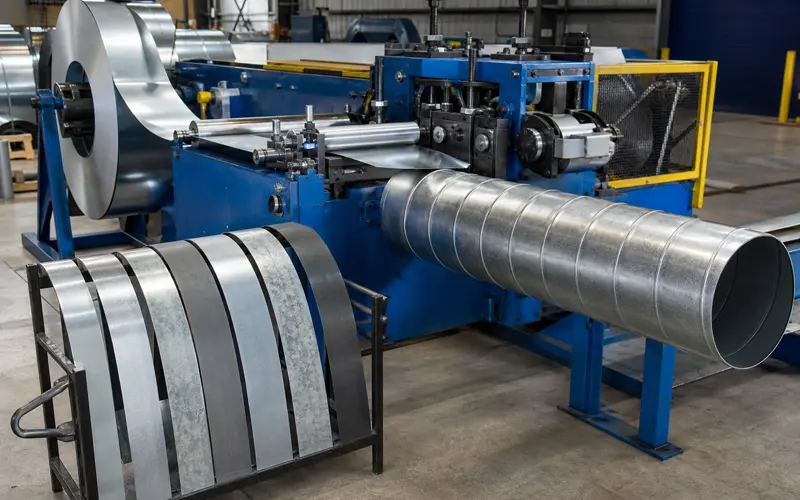
A spiral duct machine rated for 0.5 mm to 1.2 mm coil handles 26 to 18 gauge in galvanized steel. Stainless steel at the same gauge requires a machine rated for one step thicker due to higher yield strength. Coil width determines maximum output diameter.
A 5.5 kW main drive handles up to 20 gauge galvanized at 30 meters per minute. Heavier gauge or wider coil needs 7.5 kW or higher to maintain forming speed. Adding a corrugation station extends the gauge optimization range by one full step.
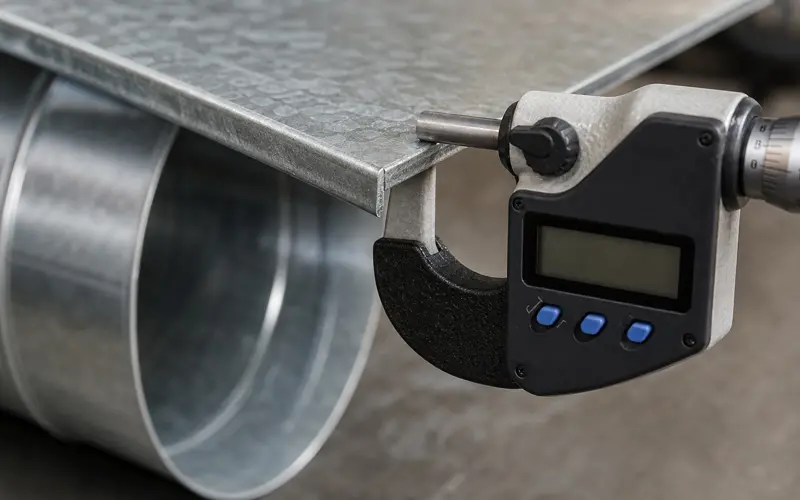
Gauge compliance is verified by measuring sheet thickness with a calibrated micrometer or ultrasonic thickness gauge. Results are compared against the project specification and against industry standards that map diameter and pressure to minimum gauge.
Sheet thickness is measured on the finished duct wall with a calibrated instrument. Three measurements per duct length, averaged, are compared against the project specification. Coating thickness is excluded from the measured value.
The negative pressure test follows a deflection criterion of diameter divided by 200. A 30-inch duct may deflect no more than 0.15 inches at the rated negative pressure. Leakage testing against industry leakage class tables confirms positive pressure compliance.
28 gauge is the floor for galvanized spiral lock-seam duct at +2″ w.g. and diameters under 14 inches. Many local commercial codes raise the floor to 26 gauge for added safety margin.
Yes. The four-ply spiral lock-seam carries hoop stress more efficiently than flat rectangular panels. It adds 20% rigidity over a longitudinal welded seam at the same gauge.
Yes. Corrugation adds bending resistance and crushing strength around the circumference. A corrugated spiral duct holds the same pressure rating as plain duct one gauge step heavier.
No. Gauge refers to the base steel thickness only. The G90 zinc coating adds 0.0017 inches across both sides but does not contribute to structural strength.
Industrial dust collection requires 22 to 18 gauge depending on diameter and negative pressure. Woodworking systems handling heavy chips need 18 gauge minimum for trunk lines. Corrosive systems push to 16 gauge with stainless steel.