Hydraulic vs Servo Tube End Forming: Which to Buy?
Jump to section
A hydraulic or servo tube end forming machine should be chosen by the finished part, not by the drive name alone. Hydraulic systems suit stable jobs that need firm, direct forming force. Servo systems suit programmed motion, fast product changes, and line automation.
The right choice also depends on tube material, outside diameter, wall thickness, end shape, cycle time, and quality limits. Tooling matters just as much as the power system. An advanced drive cannot correct a poor die or the wrong forming method. Drawings, tube samples, sample trials, and a factory acceptance test should confirm the final machine design before shipment.
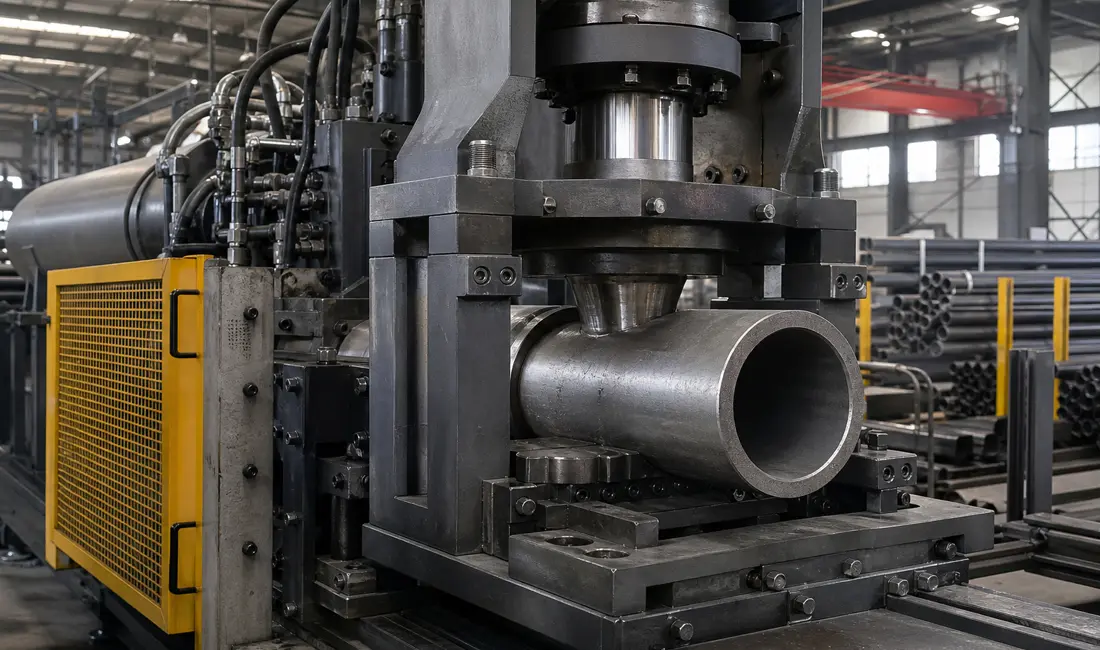
A hydraulic tube end forming machine is industrial equipment that uses pressurized oil to move a forming tool, clamp, or cylinder. It suits processes that need steady force, firm holding, and a simple repeated stroke.
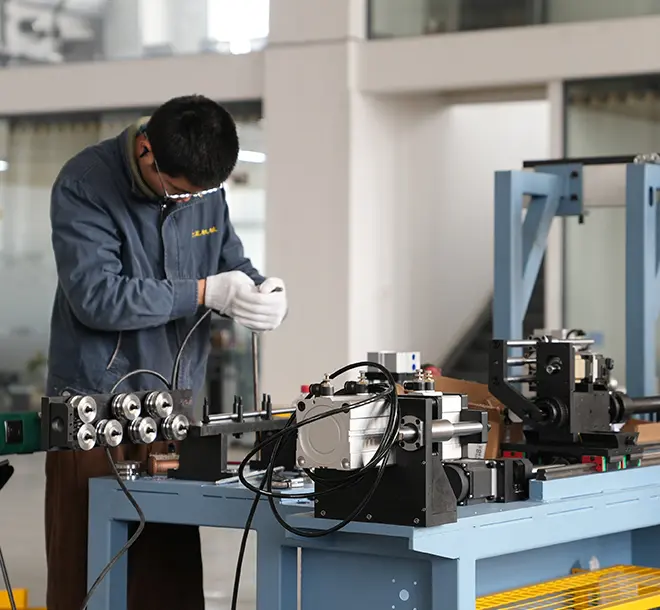
A hydraulic system creates movement through a pump, valves, and cylinders. A cylinder pushes a punch, die, or clamp through a set stroke. The tool then expands, reduces, bulges, beads, or shapes the tube end. The cycle can use one direct stroke or several tools in sequence. The right method depends on the final profile and how much metal has to move. Hydraulic power does not set tube size by itself. Capacity depends on material, wall thickness, shape change, die area, and machine frame. BOBO’s hydraulic capillary tube forming machine shows this at the small end of the range. It forms 1.0mm to 5.0mm diameter tube, with wall thickness up to 0.8mm. A foot pedal triggers the hydraulic stroke, and the machine is built for HVAC, refrigeration, and automotive fuel and brake line work.
Hydraulic forming fits best where a part needs firm pressure through a controlled distance. It also suits jobs that need strong clamping to hold a tube in place. Hydraulic systems are common across industrial plants, so many maintenance teams already know their main service points. On a stable product mix, a simple hydraulic cycle can meet the output target without added motion control. That makes it a practical fit for evaporator, condenser, and refrigeration line-set production, where the same tube and end shape run for long periods.
Hydraulic tube end forming needs regular fluid-system care. Oil, filters, seals, hoses, and valves need planned checks. Long runs may also need added heat control. A basic hydraulic pump can keep running while the tool sits idle, so energy use depends on the circuit and control method. Modern on-demand systems use less energy than older fixed-speed ones. Hydraulic equipment can also add noise, heat, and oil-handling work, though machine design can reduce these effects.
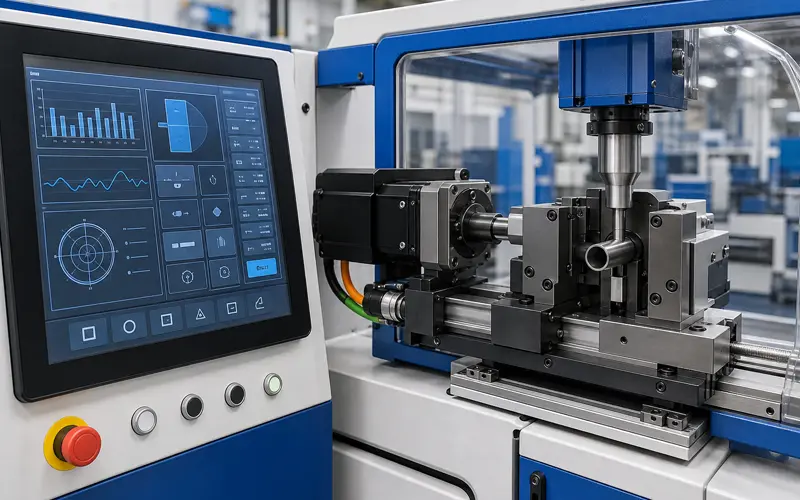
A servo tube end forming machine is industrial equipment that uses closed-loop motors to control tool position, speed, and movement. It suits processes that need stored recipes, shaped motion, or a link to automatic handling systems.
A servo system uses a motor, drive, encoder, and controller to move an axis. The encoder reports axis position. The controller then adjusts the movement to follow a set path. Servo control can guide a punch, spinning roller, feed axis, transfer unit, or tool slide. It can also run several axes together during multi-step work. A servo machine is not always fully electric. Some pair servo forming axes with hydraulic clamping. Others use pneumatic loading and unloading. A practical design may combine all three. BOBO’s copper tube spinning machine T-40 is one example. It runs two servo axes at ±0.02mm positioning accuracy. It shrinks, flares, or reduces copper tube from 16mm to 32mm in diameter, and finishes both ends of a tube in one 45-second cycle.
Servo forming fits best where movement needs to be programmable. A supplier can set tool travel, speed, and sequence for each part. Stored recipes cut setup work when a plant switches between tube sizes or end shapes. Servo control also supports stable repeatability when the end form depends on a set tool path. The same movement runs each cycle, as long as tooling, material, and setup stay controlled. Servo axes work well with feeders, loaders, sensors, alarms, and line controls. That is why they show up often in automotive AC line and heat exchanger production, where a plant runs many part numbers.
Servo tube end forming needs the correct motor and drive size for the job. An undersized system will not deliver enough force or speed. An oversized one adds cost without improving the part. Servo systems also need trained support and planned spare parts for drives, motors, encoders, cables, and motion parts. A simple job that rarely changes may not earn back the added cost of a servo system. A hydraulic or pneumatic machine can often meet the same need with a simpler design.
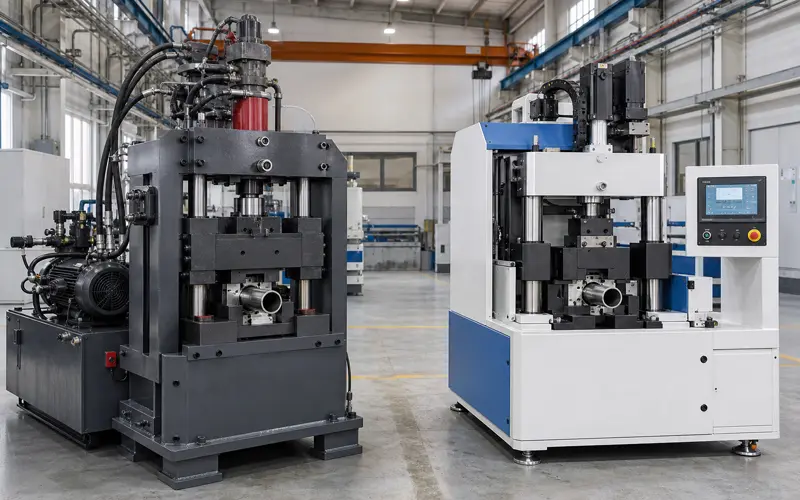
Hydraulic and servo tube end forming machines differ mainly in how they create and control movement. Hydraulic systems lead with fluid force and direct cylinder strokes. Servo systems lead with programmed position, speed, and path control. Hybrid machines use both, pairing a servo axis for positioning with a hydraulic cylinder for clamping or force.
| Buying Factor | Hydraulic Tube End Forming | Servo Tube End Forming |
| Main control strength | Stable force and direct strokes | Programmed position, speed, and path |
| Product change | Good for stable, repeated jobs | Good for frequent recipe changes |
| Automation | Works with PLCs, feeders, and sensors | Well suited to multi-axis, multi-station lines |
| Maintenance focus | Oil, filters, seals, valves, cylinders | Motors, drives, encoders, cables, screws |
| Utilities | May need oil cooling and pump power | Draws power mainly during motion |
| Best fit | Force-focused work with limited change | Flexible work with controlled movement |
Neither drive type wins on force by default. Required force depends on tube material, outside diameter, wall thickness, forming length, shape change, friction, and die design. Hydraulic cylinders are a practical way to deliver a strong, direct stroke. Servo axes reach high force too, once the motor and mechanical drive are sized correctly. Either way, a supplier should confirm the load against real part data or a sample trial, not a general spec sheet.
Position control is where servo systems pull ahead. The controller sets travel, speed changes, dwell points, and return positions directly. That direct control is how the T-40 holds ±0.02mm on both forming axes. Hydraulic systems can still hit stable results with the right sensors, stops, and valves. But part quality then leans more on tube variation, die wear, and lubrication. Axis accuracy is not the same as part tolerance either way. The finished tube still needs its own inspection.
Neither system is faster in every case. A full cycle includes loading, clamping, forming, tool return, unloading, inspection, and part transfer. Each step adds time on both machine types. Servo systems support quick recipe recall between parts, which favors mixed production. Hydraulic systems can run very fast on a fixed part with a short, direct stroke. Servo systems can match that speed too when the axes are well matched to the part, as shown by the T-40’s 45-second two-end cycle.
Energy use depends on the whole machine and its duty cycle, not the drive type alone. A fixed-speed hydraulic pump can keep running through idle time. A servo axis typically draws more power while moving and less while stopped. That pattern usually nets out lower energy use on start-stop cycles. Maintenance follows a similar divide. Hydraulic machines need oil, filter, hose, seal, and cylinder checks. Servo machines need motor, drive, encoder, cable, and guide-screw checks. Total cost should also include tooling, setup, training, scrap, spare parts, and downtime, not just utility bills.
Buyers should start with the finished part, required output, and factory conditions. The drive system should be selected only after those needs are clear.
Tube material, diameter, and wall thickness set the basic forming load. Material grade and hardness affect how the tube forms under that load. Tube length and straight clamping length matter too. A bend near the tube end may need a special clamp, or a process that keeps the workpiece still during forming.
The tube end shape decides the forming method. Expanding, reducing, flaring, beading, bulging, grooving, closing, trimming, and chamfering each call for different tools and movements. A large shape change may need more than one forming stage. This lowers the risk of cracks, folds, or heavy wall thinning. The drawing should show key dimensions and state the joint function, such as brazing, welding, sealing, or assembly. That function sets the tolerance the part actually needs. Useful inspection points include outside diameter, inside diameter, length, roundness, concentricity, surface marks, cracks, wall thinning, and burrs. Samples or tooling trials should confirm any tolerance promise before it goes on a spec sheet.
Production volume and product mix decide how much automation pays for itself. A stable part that runs for long periods can suit a simple hydraulic machine. A plant with many part numbers gains more from servo recipes and quick changeovers. Manual loading suits small batches. Automatic loading, turning, and unloading suit high output, once the part can be fed in a stable way. This is where hybrid designs earn their keep. BOBO’s tube end forming machine range includes machines that pair servo-controlled axes with hydraulic clamping and automatic handling. That combination works well when a process needs controlled tool movement and firm work holding in the same cycle.
Tooling should be reviewed as part of the machine, not as an afterthought. Die material, forming stages, contact area, lubrication, and changeover access all affect part quality and daily use. A stored recipe does not remove every manual task. A supplier should state which settings change by program, and which dies, chucks, guides, or feeders still need manual work. A sample trial should confirm the process before final approval. It should show whether the tube cracks, wrinkles, slips, scratches, or drifts outside the accepted size. A factory acceptance test then confirms the agreed output and machine functions. This covers sample quality, cycle steps, controls, alarms, guards, loading, recipe change, and inspection results.
A manufacturer should choose hydraulic tube end forming for a stable, force-focused job. This fits best where simple, proven operation brings the most value, such as a long production run of one or two end shapes on the same tube size. A manufacturer should choose servo tube end forming when programmed movement, recipe control, or line automation brings more value. This fits an automotive AC line or heat exchanger cell that switches between several tube diameters in a shift. A servo-hydraulic machine fits best when a process needs precise axis control and firm hydraulic clamping in the same station. That combination suits any part that must be positioned exactly, then held under real force to form. The decision does not need to follow a strict hydraulic-versus-servo rule. It should follow the part, the tooling, and the production need.
The final choice should rest on drawings, samples, cycle targets, and acceptance tests, not on a feature list alone. A machine that makes an approved part at a stable rate is worth more than one chosen only for its drive type. Manufacturers planning a new tube end forming project can send BOBO Machine the tube drawing, material, diameter, wall thickness, end shape, and output target. The engineering team can then review the process and propose a standalone machine or a full line solution to match.
Usually not without changes. Mounting style and stroke length differ between drive types, even when the forming principle stays the same, such as expanding or flaring. A die can often be re-engineered for a new mounting, but it rarely bolts straight across.
Basic loading and unloading skills carry over. Servo systems add a control panel and stored recipes, which need extra training. Plants that already run PLC-controlled hydraulic equipment usually adapt faster than plants moving from fully manual machines.
Yes. PLC-controlled hydraulic stations and servo stations can sit side by side on one tube processing line. They can share upstream cutting or bending stations, and downstream welding or testing stations.